
Pentagon Drone Production Funding Push Reaches $50B in New Reconciliation
Pentagon drone production funding took center stage at AUSA’s Project Agincourt panel this week, where Defense Secretary Pete...
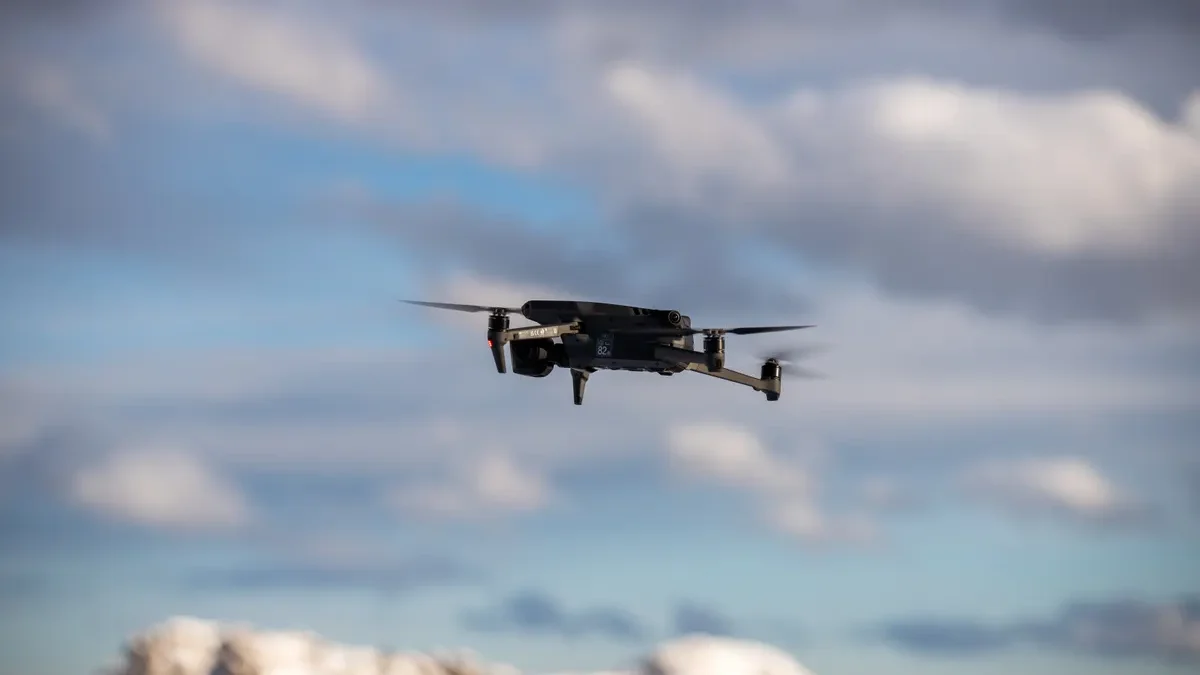
The U740 Valkyrie European flight program hit a concrete milestone on October 12, 2026, when Kratos Defense and Airbus completed the aircraft’s maiden flight over northern Europe, at a test site the companies declined to name. For investors in Kratos (KTOS), the flight is less about the aerobatics and more about what it validates: a low-cost attritable combat drone model is now airborne in Europe with a credible 2029 delivery target attached to it.
The test accomplished the full objective list, according to the Airbus press release: an independent rocket-assisted takeoff, maneuvers at multiple altitudes, speeds up to Mach 0.8, and in-flight mission adjustments. The aircraft is 30 feet long with a 27-foot wingspan, a max takeoff weight above 6,000 pounds, a range exceeding 3,000 miles, a service ceiling of 45,000 feet, and an internal bay for both air-to-air and air-to-ground munitions.
Kratos CEO Eric DeMarco said that while “first flights typically include plenty of learning opportunities,” he called the test “an amazing success” given the maturity of the technology. The Valkyrie is designed to fly autonomously or under the direction of a crewed fighter such as the Eurofighter Typhoon, according to Airbus’s crewed-uncrewed teaming documentation.
Airbus Defence and Space CEO Mike Schoellhorn framed the strategic logic plainly: “In an increasingly complex and contested threat environment, air forces require affordable combat mass today.” The Valkyrie pairs Kratos’s low-cost airframe with Airbus’s European mission system, allowing European air forces to add attritable mass without the unit-cost burden of crewed platforms. Per the March 2026 Airbus announcement, two Valkyrie airframes were already in preparation for integrated flights with the MARS mission system, not just the one that flew in October.
The companies describe MARS (Multi-platform Autonomous Reconfigurable and Secure) as the Valkyrie’s “European brain,” with humans retaining control over all critical decisions. The deeper capability inside MARS is an AI-supported software layer called MindShare, which Airbus describes as able to coordinate entire mission groups by distributing itself across multiple manned and uncrewed platforms simultaneously. That makes MARS more than an autopilot: it is an architecture positioned as a force-multiplier for multi-domain operations and, according to the Airbus MARS Mission System page, a building block for the Future Combat Air System (FCAS).
The next phase of testing will integrate MARS more fully. Beyond the Valkyrie, Airbus is already developing its successor, the U760 Ravenstorm, slated for the early 2030s with an internal payload capacity exceeding 500 kg for air-to-air, air-to-ground, and electronic warfare missions. That roadmap matters for KTOS because it implies a sustained production and upgrade relationship with Airbus, not a single-program arrangement.
The bear read is straightforward: a successful first flight is a long way from operational deployment, and the 2029 combat-ready target set by the Kratos-Airbus partnership will require integrated MARS testing, further airworthiness certification in European airspace, and procurement commitments from Germany and other partner nations that have not yet been publicly confirmed. The program could slip. European defense budgets, while rising, remain politically sensitive, and CCA acquisition timelines across NATO have a history of stretching.
Separate from the Valkyrie news, Kratos disclosed flight test results for its TDI-J85 turbojet engine across three distinct configurations: Lugged Launch, Palletized Launch, and Surface-to-Surface applications, the last of which covers containerized munitions launched from a container, according to the Kratos TDI-J85 press release. That multi-configuration versatility across cruise missiles, decoys, and unmanned aerial systems is the commercial argument: one engine platform, multiple addressable markets.
Senior VP Joseph Kovasity said Kratos recently scaled operations to meet manufacturing orders for 3,000 engines in 2027, with positioning to produce up to 10,000 engines or more per year by 2029. The Kratos newsroom also confirms the company is supplying Spartan J85 engines to support a Boeing JDAM LR production contract, which signals that this engine ramp already has a named, high-volume customer behind part of the demand.
The J85 story may be the more actionable near-term read for KTOS shareholders. The Valkyrie validates the platform strategy and extends the European CCA pipeline, but the engine volume numbers, with a named Boeing relationship underpinning them, represent revenue that is closer to recognized. The risk is execution: scaling from hundreds to tens of thousands of engines annually is a manufacturing challenge, not just an engineering one. Whether Kratos can hold unit economics at that volume is the question the next several quarters of results will answer.
Pentagon drone production funding took center stage at AUSA’s Project Agincourt panel this week, where Defense Secretary Pete...
The Army Cyber Mastery Incentive pay program has been generating alarm in the ranks since its October 1...

The US Army brain health assessment program has reached 97% completion across active duty, National Guard, and Reserve...