Army Cyber Mastery Incentive Pay Won’t Cut Soldier Wages, General Says
The Army Cyber Mastery Incentive pay program has been generating alarm in the ranks since its October 1...
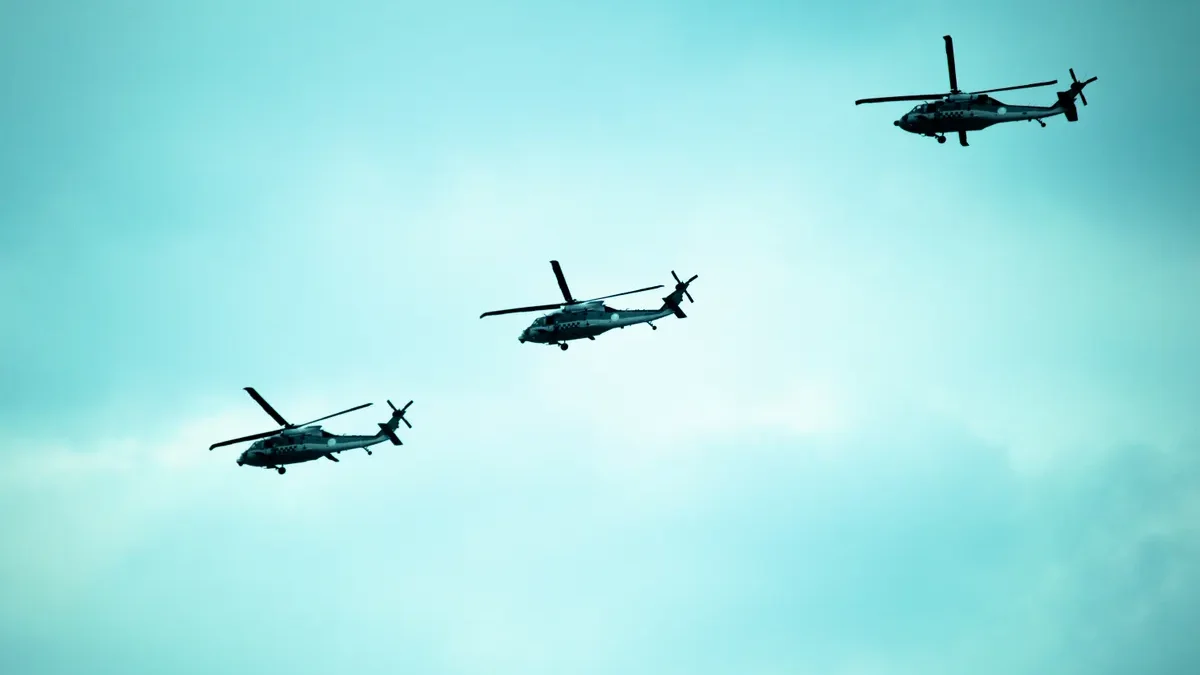
Pentagon drone production funding took center stage at AUSA’s Project Agincourt panel this week, where Defense Secretary Pete Hegseth disclosed a request for roughly $50 billion in reconciliation spending to scale autonomous and robotic systems, a figure that sits entirely outside the department’s regular budget cycle.
The request is a one-time investment, Hegseth said, not a recurring line item. Its purpose is to compress years of development and procurement into a much shorter window, pushing output to what he described as volumes the department has never attempted.
The $50 billion reconciliation ask is distinct from the DoD Comptroller’s FY2027 budget request, which includes a separate $53.6 billion Drone Dominance allocation structured across five areas: Asset Purchases and Industrial Demand Signal ($16.9 billion), Counter Autonomous Systems ($14.4 billion), Contested Logistics ($13.5 billion), Collaborative Autonomy ($4.5 billion), and Force Generation ($4.3 billion). Those five components sum to $53.6 billion and are framed in the FY2027 budget document as a multi-year investment.
Together, the two spending streams point toward an overall ambition the Federal News Network puts at upward of $55 billion for autonomy and robotics, which incorporates $1.2 billion lawmakers already approved through a prior reconciliation bill. The reconciliation portion remains contingent on congressional action, which is where the real execution risk lives.
Hegseth tied the reconciliation funding explicitly to two new organizational constructs he announced in September 2026: Project Agincourt and its successor, the Autonomous Warfare Command, or AUTOWARCOM. Breaking Defense reports that the Pentagon has already shifted its Direct Reporting Portfolio Manager for autonomy into Project Agincourt ahead of congressional approval, signaling the department is building the organizational structure before the money is secured.
Hegseth was direct about the scale the department is targeting. “Ultimately we will be dealing with hundreds of thousands of one-way attack systems this year and into the millions in years to come at a pace that this department’s never ever seen before.”
The Army’s existing Drone Dominance program gives that ambition a concrete reference point. In a December 2025 announcement, the Army said a $1 billion initiative would fund approximately 340,000 small unmanned aircraft systems for combat units over two years, with tens of thousands expected in 2026 and hundreds of thousands by 2027.
Reaching production at that pace requires a different industrial base than the one that built F-35s. Hegseth said the Department of Defense must lower barriers for companies outside the traditional prime-contractor ecosystem while keeping established firms in the mix for platforms that require their scale and engineering depth. Acting Army Secretary Adam Telle echoed the same point, saying the Army is deliberately broadening access to programs for non-traditional entrants.
The Army is also restructuring internally to absorb the shift. According to Air and Space Forces Magazine, Acting Army Chief of Staff Gen. Christopher LaNeve revealed on October 13, 2026 that the service has redesignated its Futures and Concepts Command as the Army Futures and Autonomous Systems Command and is introducing UAS and robotics military specialties across its formation. Telle described plans to distribute autonomous-systems capabilities, including drones, autonomous ground systems, autonomous fires, and autonomous lift, directly to operational units rather than concentrating them in specialty formations.
Hegseth framed the regulatory environment as an equal obstacle to the industrial one. “I want you to tell me which rules can be signed away,” he told the panel, urging officials to identify directives that could be changed by executive action rather than legislation.
For defense investors, the combined spending signal, roughly $50 billion in reconciliation plus $53.6 billion in the FY2027 base budget, is the largest stated commitment to unmanned systems in the department’s history. The bull case is straightforward: companies positioned in small-UAS manufacturing, counter-drone systems, and autonomous software stand to benefit from a procurement surge unlike anything in the post-Cold War era, particularly non-traditional primes that the Army is explicitly trying to pull in.
The bear case is equally clear. The reconciliation bill has not passed. The $50 billion is a request, not an appropriation, and reconciliation vehicles are subject to parliamentary rules, vote counts, and timeline uncertainty that the department cannot control. Hegseth’s organizational moves, standing up AUTOWARCOM and consolidating autonomy programs under Project Agincourt before the money exists, look like a bet that congressional approval follows. If it does not, the command structure exists without a funding base.
The deciding variable is congressional: whether the reconciliation bill clears in a form that preserves the autonomy allocation. Until that question is answered, the spending ambition is real and the stocks it would lift are identifiable, but the catalyst itself remains pending.
The Army Cyber Mastery Incentive pay program has been generating alarm in the ranks since its October 1...

The US Army brain health assessment program has reached 97% completion across active duty, National Guard, and Reserve...
Kongsberg’s Poland counter-drone factory plan, announced at the Warsaw Security Forum on October 12, is more than a...