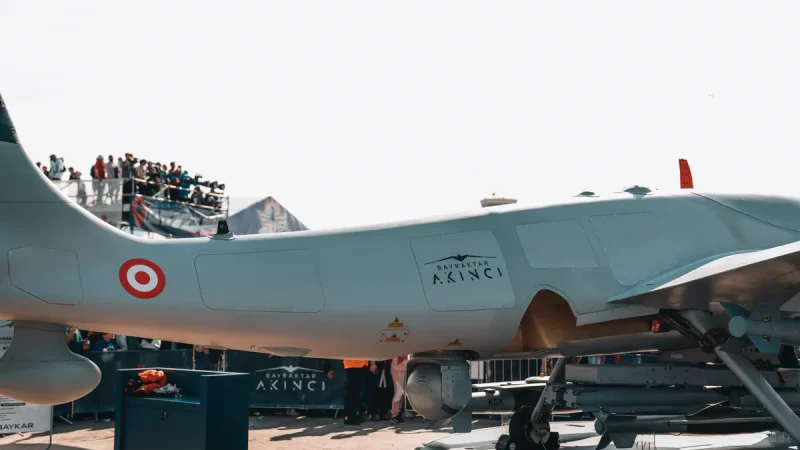
Vector and Nammo Armed Drones Scale Up for Mass Production
Vector Defense and Nammo announced an expanded partnership Monday at the Association of the United States Army’s annual...
Global defense budgets are experiencing an anomaly, and the figures are beginning to resemble a warning rather than a spreadsheet. A very different ranking appears when you look past the well-known numbers, such as the Pentagon’s $997 billion and China’s $314 billion, and sort the world according to how much of each nation’s economy is truly allocated to its military. Algeria, Israel, and Ukraine are the top three nations on that list in 2026. They are all not conventional superpowers. All three are spending at levels typically associated with mobilization during a war, according to historians. These figures have a subtle intensity that is difficult to ignore.
Ukraine is the obvious story, but that doesn’t make it any less dramatic. Approximately 34% of the nation’s GDP was allocated to defense in 2025; ten years ago, this percentage would have been unimaginable in any European economy. Small, commonplace details such as air-defense sirens incorporated into smartphone apps, public buses rerouted around reconstruction zones, and weapons manufacturers running around the clock are examples of how the evidence is visible when you stroll through Kyiv today.
European and American suppliers who keep the front supplied are the immediate beneficiaries, not Ukrainian businesses, the majority of which are still struggling. One of the more understated winners is BAE Systems (LON: BA.). Since 2023, the company has expanded its production of artillery shells in Pennsylvania and the UK several times, and investors appear to think the order book is secure well into the late 2020s.
Then there’s Algeria, which should receive more attention but seldom appears in front-page financial news. Tensions with Morocco over the Western Sahara drove the country to spend nearly 8% of its GDP on defense in 2025, the second-highest percentage in the world. This expenditure was mostly financed by natural gas revenues.
In the past, at least, the majority of Algeria’s purchases go to Russia, but this is changing. Algiers has been pushed toward European and Chinese suppliers by sanctions, supply delays, and lessons learned from the Ukrainian battlefield. Although it’s still unclear if Algeria will fully diversify, businesses like France’s Thales Group (EPA: HO) have been vying for a share of that shift, and some of that optimism has been reflected in the stock.
Perhaps the most complex example is Israel, which is ranked third on the per-GDP list. Due to the protracted Gaza conflict, the 2025 exchanges with Iran, and the reconstruction of northern border infrastructure damaged during the Lebanon operations, Israeli defense spending has increased to levels not seen in decades, at about 8.78% of GDP. Defense contractors in Tel Aviv are exporting as well as selling domestically. Since early 2023, Elbit Systems (NASDAQ: ESLT) has grown by more than 180%.
The company’s growth story is remarkably straightforward: allied militaries are now placing bulk orders for drones, loitering munitions, electronic warfare, and artillery systems. Fund managers believe that Elbit has evolved into what Lockheed Martin was in the early 2000s for the current decade: a stock you buy because the world keeps telling you that you probably should, rather than because you want to.
Everything comes together when you look at the bigger picture. In 2025, the United States alone has a $1.5 trillion budget under the current administration, NATO allies increased their budgets by 20% in a single year, and global defense spending reached $2.6 trillion. Investors are finding it more difficult to ignore the pattern. As this develops, it’s easy to portray the rising defense stocks as a clear opportunity, but there’s a darker reality at play: these businesses are expanding because the world is becoming less stable. Israel, Algeria, and Ukraine are the best examples. Gains in the portfolio are genuine. And so are the causes of their existence.
Vector Defense and Nammo announced an expanded partnership Monday at the Association of the United States Army’s annual...

The TSMC earnings season preview is the week’s focal point, with Taiwan Semiconductor Manufacturing (TSMC) reporting Thursday as...

The EU-China hybrid deal announced on October 9 in Beijing is less a resolution than a redirect: Brussels...