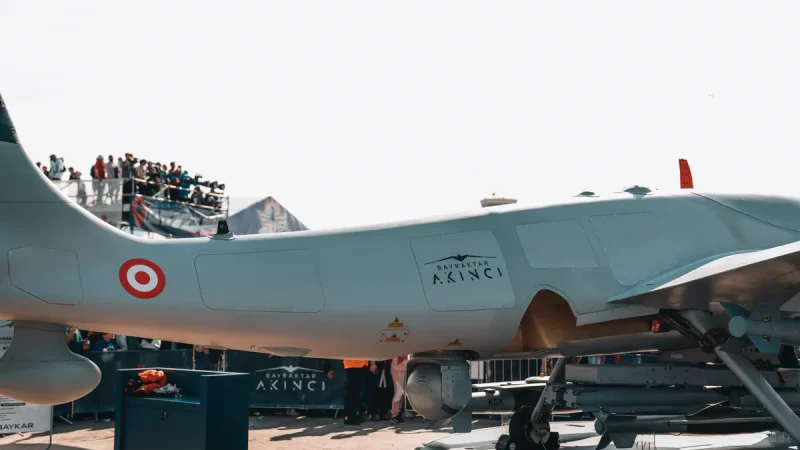
Vector and Nammo Armed Drones Scale Up for Mass Production
Vector Defense and Nammo announced an expanded partnership Monday at the Association of the United States Army’s annual...

When a research note that no one quite anticipated appears on a trading floor, a certain kind of silence descends. For the majority of 2026, Goldman Sachs has sounded cautious about technology, pointing out the weakest period for the industry in fifty years, highlighting the growing expense of AI infrastructure, and implying that the long-held beliefs surrounding Big Tech’s moat were crumbling more quickly than anyone wanted to acknowledge. Therefore, when its analysts discreetly raised price targets on three technology names this spring, it seemed more like a minor, intentional shift in perspective than a standard adjustment.
The three businesses weren’t the most obvious ones. They weren’t the well-known figures that have dominated the first half of the year, the Magnificent Seven. Rather, the improvements went to Analog Devices, Applied Materials, and Arista Networks, three companies that work in the background of the AI narrative, performing the unglamorous tasks necessary to make it physically feasible. Reading the notes gives the impression that Goldman’s team has been waiting for the hype surrounding the big names to subside so that the picking infrastructure below can finally be given a chance.
The majority of people pass Analog Devices without giving it a second thought. Its chips find their way into industrial machinery, medical sensors, and the silent devices that translate the real world into a computer-readable format. The company’s silicon is most likely sitting inside half of the boxes humming on the floor if you walk through an industrial park in Texas or Bavaria. In a year when speculative AI valuations are being penalized, investors appear to think that dull, embedded reliability is suddenly more valuable.
The second name, Applied Materials, has a more straightforward reasoning. Someone must build the machines that produce the chips if the AI buildout proceeds, even at a slower rate. Just this week, Morgan Stanley revised its own forecast for the company, citing it as one of the cleanest ways to play infrastructure spending without falling for the chip designers’ exorbitant valuations. The trade is more subdued. More compounding, less drama.
The upgrade that caused the greatest stir in Manhattan offices is Arista Networks, which completes the trio. The high-speed networking equipment that links all those AI servers within hyperscaler data centers is manufactured by Arista. For months, the bear case has been straightforward: orders thin out after Microsoft and Meta complete their major builds. It seems that Goldman is making the opposite argument. Someone must connect the billions of dollars that hyperscalers are spending on infrastructure at an unrelenting rate.
The way this aligns with the company’s overall 2026 behavior is intriguing. Even as the Iran conflict continued in April, Peter Oppenheimer was advising clients to purchase the decline in technology. The unusual correlation between the Nasdaq 100 and its call options had only occurred four times in ten years, according to Brian Garrett’s “Up Crash” note from May, and each time the market rose. It’s difficult to ignore the pattern. Goldman issues a public warning. In private, it’s leaning in toward the real price targets.
The company hasn’t fully resolved this tension, and perhaps it shouldn’t. While the larger tech complex has reset, semiconductor ETFs have performed better. The Mag 7 trade appears worn out. The converters, etch tools, and routers are the picks and shovels where money is rotating. It’s still unclear if this is the beginning of a real change in leadership or if the giants will simply take a break before making their usual reassertions.
As this develops, the upgrades seem more like an observation than a forecast. Something caught Goldman’s attention. The market is still lagging behind. We’ll only know in retrospect whether that gap closes or subtly vanishes like so many analyst calls do.
Vector Defense and Nammo announced an expanded partnership Monday at the Association of the United States Army’s annual...
The TSMC earnings season preview is the week’s focal point, with Taiwan Semiconductor Manufacturing (TSMC) reporting Thursday as...

The EU-China hybrid deal announced on October 9 in Beijing is less a resolution than a redirect: Brussels...