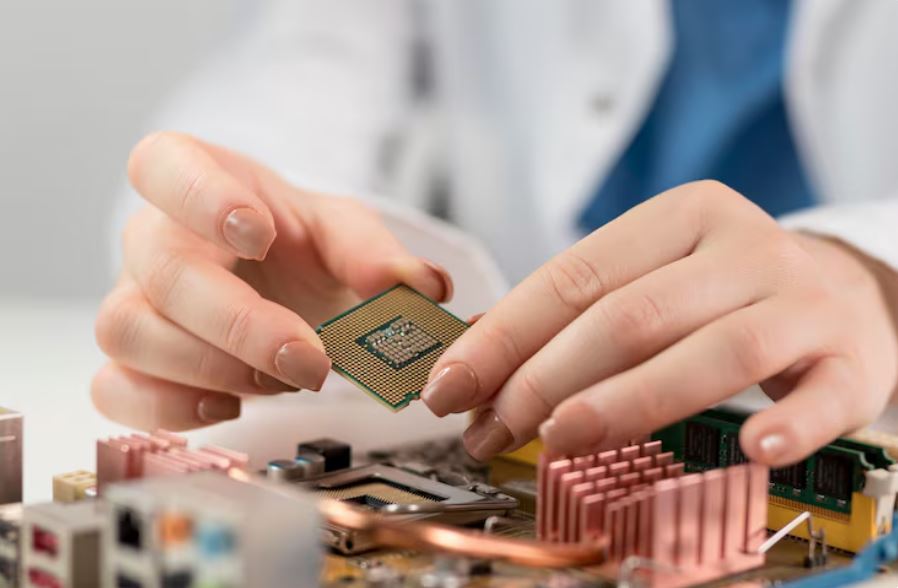
The Chip Stock Symbiosis: Why Semiconductor Surges Are Lifting Automotive Industrial Shares
The discourse surrounding semiconductors has mostly adhered to a well-known script for the last two years. Nvidia, GPUs,...

In Normal, Illinois, there is a section of the factory floor where you can stand and count cars. Beyond the loading bay, rows of R1S SUVs were arranged with sunlight slicing through their windshields. A few R1T pickup trucks are awaiting transportation. Prototypes of the R2, the smaller, less expensive SUV Rivian believes will save its next five years, have also surfaced recently. The plant is not silent. It’s also not exactly humming. It’s operating somewhere in the middle, similar to how a startup carmaker operates when attempting to grow into a market where the objectives are constantly changing. Rivian’s stock is currently trading at $16.41, neither falling nor rising as it waits for a break.
Rivian has increased 32% in the last year, which may seem like a success story, but keep in mind that the stock went public in November 2021 at about $78. With an Amazon van contract in hand and Jeff Bezos’ support, Ford is considering becoming an investor. For a brief period in late 2021, it was worth more than General Motors and was intended to be the Tesla competitor. Then came reality. issues with the supply chain. delays in production. increasing losses. a stock that began to recover after losing over 85% of its peak value. Those who purchased the most recent bounces are keeping an eye on whether the next catalyst holds, while those who are still holding from the IPO are completely underwater.
Actually, this stock will be defined by two catalysts until 2031. The R2 is the first. The R1S SUV and R1T pickup in Rivian’s current lineup are high-end vehicles. Most configurations have starting prices above $70,000, placing them in direct competition with high-end gas-powered SUVs and, most importantly, out of reach for the mass market that Tesla’s Model Y has been steadily taking over since 2020. In 2025, the Model Y was the world’s best-selling car. Not the most popular EV.
The best-selling vehicle. With customer deliveries planned for the second quarter, Rivian is attempting to break into that market this year with the R2. The R2 is priced for combat. The revenue trajectory will shift in a way that the stock price does not currently reflect if Rivian is able to attract even a small percentage of mid-size SUV buyers who are receptive to an American EV alternative.
However, the skeptics are right. Earlier this month, DA Davidson upgraded Rivian from Underperform to Neutral, pointing out that R2 pricing for early trims was 55% more than some customers had anticipated. If Rivian is relying on volume to make the investment worthwhile, that is a problem. The entire purpose of entering the market is lost for a mid-size EV that is priced more toward premium than affordable. This year, Rivian hopes to deliver between 20,000 and 25,000 R2 vehicles, a small portion of what Tesla does in Europe alone. Everything is altered if the R2 lands as planned. The stock is likely to retrace if it doesn’t.
The second catalyst is more ambitious and unfamiliar. Uber and Rivian have an agreement for Rivian to supply 10,000 fully autonomous R2 models beginning in 2028 and an additional 40,000 by 2030. Uber will invest up to $1.25 billion in the deal, which includes a $300 million upfront payment that will be triggered upon regulatory approval. However, there is a catch: the entire deal depends on Rivian being able to drive autonomously at Level 4. This means that the vehicles must operate autonomously within predetermined areas without human assistance. This hasn’t been accomplished by Tesla yet. Waymo has, but only after ten years of development and significant capital expenditures. Rivian has postponed its EBITDA profitability targets in order to finance its bet that it can reach the Uber deal quickly enough.

That is a very dangerous wager. One of the most challenging engineering issues in contemporary transportation is level 4 autonomy. Businesses with greater resources, data, and expertise have found it difficult to make the final mile. A 50,000-vehicle fleet order from Uber at scale would drastically alter the company’s revenue profile, and if Rivian meets the deadline, the stock price rises sharply. The benefits of the first announcement vanish and some of management’s credibility is lost if Rivian fails. Compared to Elon Musk and Adam Aron, Scaringe has always been the more composed, engineer-founder type. However, measured does not enable unattainable goals. They simply sound more serious as a result.
In the meantime, the balance sheet is making every effort to maintain stability. Rivian reported $1.29 billion in Q4 2025 revenue, a 25.8% year-over-year decrease that was partially caused by the federal EV tax credits expiring in late 2025, which had an impact on industry demand. Even patient investors are alarmed by the gross margin, which is still negative at -276.59%. Deliveries for the first quarter of 2026 totaled 10,365 vehicles, up 20% year over year. This was a positive indication of demand trends and contributed to the stock’s 3% intraday gain on April 2.
Observing Rivian over the last two years has given me the impression that the company has become quieter just when it needed to become louder. It gave up trying to make headlines. Unit economics was its main focus. It deployed more than 100 recycled EV packs for 10 MWh of on-site storage as part of a second-life battery project at the Normal plant in collaboration with Redwood Materials. minor operational gains. The kind of story that indicates the company is looking beyond the next earnings call but doesn’t move a stock on any particular day. It is still unclear if this maturity will result in the kind of outperformance required by its shareholders.
As of right now, the stock itself is reflected in the division of the analyst community. Buy ratings of eleven. There are nine holds. Six Sells. The $18.05 consensus target suggests a slight increase from current levels. Cantor Fitzgerald’s rating of Neutral places him squarely at that number. Earlier this month, Goldman Sachs reduced its goal to $17. DA Davidson received a Neutral upgrade. It’s not being referred to as a conviction buy. It’s not being referred to as a clear sell. It is a stock that is awaiting proof. Some will come from the R2. More will be provided by the autonomy milestones. To be honest, nobody knows yet, not even the people in charge of the Normal factory, whether the evidence supports the bulls’ optimism.
The discourse surrounding semiconductors has mostly adhered to a well-known script for the last two years. Nvidia, GPUs,...

When a research note that no one quite anticipated appears on a trading floor, a certain kind of...
The way BBAI has been trading lately seems almost unyielding. Even though the stock closed at $4.37 on...