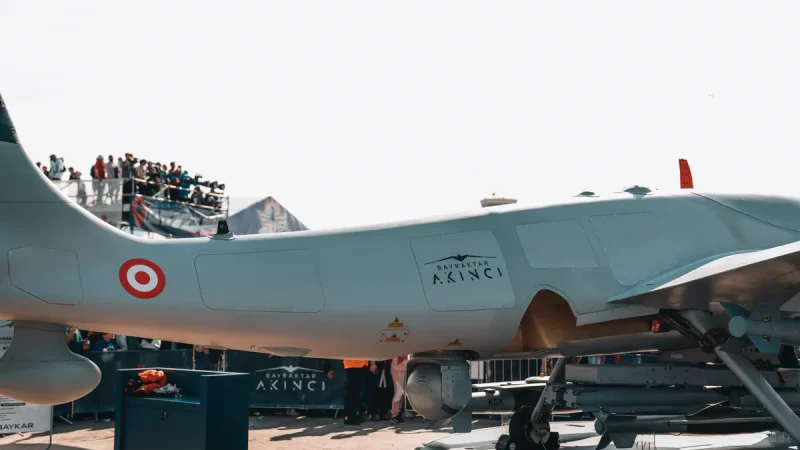
Vector and Nammo Armed Drones Scale Up for Mass Production
Vector Defense and Nammo announced an expanded partnership Monday at the Association of the United States Army’s annual...
The fact that the same seven names consistently appear at the top of the list whenever the world breaks is almost too neat. ExxonMobil, Palantir, Lockheed Martin, RTX, Northrop Grumman, General Dynamics, and now Rheinmetall—the German anomaly that made all the American defense investors a little envious. The leaderboard hardly shifts when you consider the Gulf War, 9/11, Iraq, the invasion of Russia by Ukraine, and the ongoing Iran standoff. The same dividend-paying winners, but different decades and crises.
The clearest example is still the data from the War on Terror from 2001 to 2021. By August 2021, $10,000 invested in Lockheed Martin on September 18, 2001, the day the NYSE reopened after a four-day shutdown following the attacks, was valued at about $97,295. Over a twenty-year period, that represents an 873% return. 821% was returned by Northrop Grumman. 649% for General Dynamics. For comparison, the S&P 500 returned 516% during the same time frame. Not even close. Veteran investors believe that witnessing defense primes perform better during a recession that the rest of the market was unable to weather is the best way to learn a lesson.
The invasion of Ukraine by Russia in February 2022 added a twist that no one anticipated. The largest returns from the war were not American at all. Rheinmetall, a German industrial company that had been viewed as a dormant European cyclical for decades, saw its share price rise from about €80 prior to the invasion to over €900 by the beginning of 2025. That represents a move of more than 1,000% on a stock that hardly any American investor could have identified two years ago. Hensoldt of Germany and Leonardo of Italy took comparable routes. As you pass Rheinmetall’s enlarged ammunition plant in Lower Saxony, you can see the actual growth: new structures are being constructed, shifts are working around the clock, and recruitment banners are still displayed on the fence.
Now in its third month, the Iran-Israel conflict of 2026 is eerily following the same script. By late April, the price of crude oil had surpassed $98 per barrel. The Strait of Hormuz is still disputed. ETFs for defense reached new highs. Both Lockheed and RTX have increased significantly so far this year. The pricing environment that energy CEOs only talk about in private is helping ExxonMobil. The wild card on this list, Palantir, has emerged as the AI and surveillance stand-in for a time when government spending on data is increasing more quickly than that of the private sector. Investors appear to think the pattern is reliable enough to make another wager. They may be correct.
However, the majority of retail investors overlook a catch that is hidden in the historical data. You have to be early for the pattern to work. After monitoring 29 geopolitical crises, Hartford Funds discovered that the average recovery period was 47 trading days. According to LPL Research, the average drawdown is approximately 5%. The smart money has typically positioned itself by the time CNN is providing round-the-clock coverage and the cable news graphics are color-coded. Purchasing defense stocks during the first 48 hours of confusion is not the same as purchasing them after the third week of breathless headlines. It’s difficult to ignore the fact that, in February 1991, those who profited from the Gulf War weren’t the ones glued to CNN. When everyone else was selling in October 1990, they were the ones who discreetly purchased Lockheed.
The underlying mechanism of the seven-stock framework is what makes it truly useful, not just historically fascinating. Once increased, defense budgets hardly ever decrease. From $316 billion in 2001 to $801 billion in 2021, the U.S. Since 2022, Germany has been contributing €100 billion to a special defense fund. Japan’s goal for defense spending was doubled. Australia, Poland, and South Korea have all inked multi-year procurement agreements. None of this is easily reversible. The agreements are lengthy. Once based on fear, the political consensus is difficult to break.
As you watch this play out, it seems like the 2026 version of the playbook is essentially the same, albeit with a slightly different conflict and geography. The American primes continue to be essential. Finally, the topic of European defense has come up. Every now and then, energy is reminded of its importance. As of late April, gold was trading at about $4,700 per ounce, as it always does. Additionally, the more recent additions to the list, cybersecurity and AI infrastructure, are now included in the typical war-stock basket in a manner that was not the case twenty-five years ago. It’s really unclear if the pattern will apply to the conflict that follows this one. However, as of right now, the historical record is remarkably consistent in terms of who prevails when the world becomes silent.
Vector Defense and Nammo announced an expanded partnership Monday at the Association of the United States Army’s annual...

The TSMC earnings season preview is the week’s focal point, with Taiwan Semiconductor Manufacturing (TSMC) reporting Thursday as...

The EU-China hybrid deal announced on October 9 in Beijing is less a resolution than a redirect: Brussels...