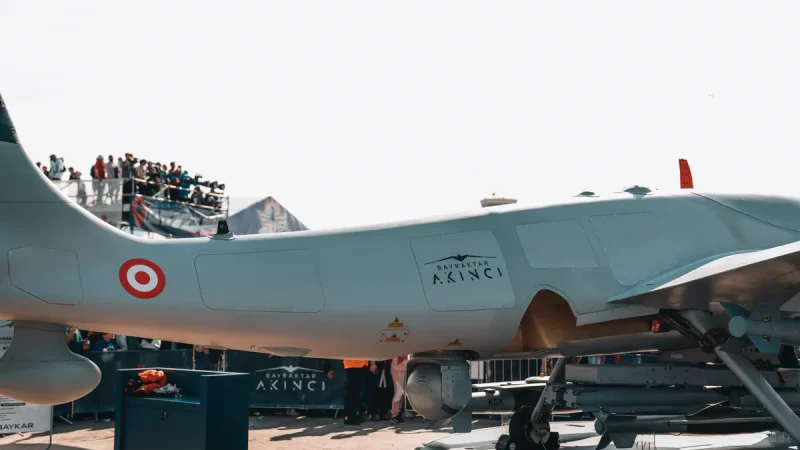
Vector and Nammo Armed Drones Scale Up for Mass Production
Vector Defense and Nammo announced an expanded partnership Monday at the Association of the United States Army’s annual...

EHang has a subtle peculiarity that makes it challenging to fit into the typical investor categories. It’s not quite an aerospace pure-play, it’s not quite Joby, it’s not quite Archer, and it’s not quite a Chinese drone company. When you enter its Guangzhou headquarters, you’ll find something more akin to a robotics lab than a conventional aircraft manufacturer: engineers huddled around tiny autonomous aircraft that resemble oversized consumer drones rather than the elegant air taxis of Silicon Valley marketing decks. It matters that visual difference. It explains a lot of why the market is still having trouble setting a fair price for this stock.
EHang is trading like a company that investors have half-abandoned at $10.37, down more than 6% in a single session and about 50% below its 52-week high of $20.85. However, that picture is not entirely supported by the fundamentals. Even though the entire year ended at a loss, the company reported its first-ever profitable quarter with revenue of 243.78 million yuan in Q4 2025, up 48% year over year. Ten years ago, a Tesla chart would have been illuminated by this kind of turning point. Here, it gave off a quick bump before fading. Investors appear to hold a belief, but they are unable to agree on what.
Geography contributes to the hesitancy. At a time when Chinese ADRs aren’t particularly popular on Wall Street, EHang is a Chinese ADR. Every quarterly report feels like it has an asterisk because of delisting concerns, audit disputes, and the slow-burning tension between Beijing and Washington. The company’s collaboration with the CAAC, which resulted in the first type certification for a passenger-carrying autonomous aerial vehicle in history, is truly unprecedented. However, in the American financial press, where Joby’s Toyota partnership and Archer’s United Airlines deal tend to take center stage, that accomplishment has been oddly muted.
With 16 EH216-S planes and over 22,000 synchronized drones, EHang lit up the skies above during this year’s Spring Festival Gala. This kind of technological theater would have made headlines for a week in another nation. Rather, it appeared on Western financial feeds as a footnote. It’s difficult to ignore that pattern. The stock continues to drift sideways while the company continues to deliver engineering milestones that would typically cause a stock to move.
Analysts are not giving up. A revised target of $16 was recently flagged by Simply Wall St, indicating that the story is changing rather than collapsing. The consensus one-year target is approximately $18.99, which is almost twice current levels. Several coverage houses have maintained a Moderate Buy rating despite short-term sentiment fluctuations. There’s a feeling that EHang is being viewed as a long-term investment—a modest stake held patiently while one waits for either commercial scaling or clarification from regulatory tailwinds.
The difference between what the company is doing and how the market perceives it is what makes this moment more intriguing than the share price. Prototypes are not being sold by EHang. It is operating a certified aircraft. Booking revenue is what it is. It is producing positive net income, at least momentarily. Nevertheless, the stock moves as though none of that is true. Perhaps it isn’t, completely. Perhaps scaling urban air mobility in China will encounter challenges that have not yet been factored in. However, as this develops, there’s a sense that EHang is the kind of stock that is disregarded until the day it isn’t.
Vector Defense and Nammo announced an expanded partnership Monday at the Association of the United States Army’s annual...

The TSMC earnings season preview is the week’s focal point, with Taiwan Semiconductor Manufacturing (TSMC) reporting Thursday as...
The EU-China hybrid deal announced on October 9 in Beijing is less a resolution than a redirect: Brussels...