
Levi Strauss Profit Guidance Climbs on Tariff Refunds, But the Revenue Picture
Levi Strauss (LEVI) lifted its full-year profit guidance after pocketing a substantial tariff refund in its fiscal third...
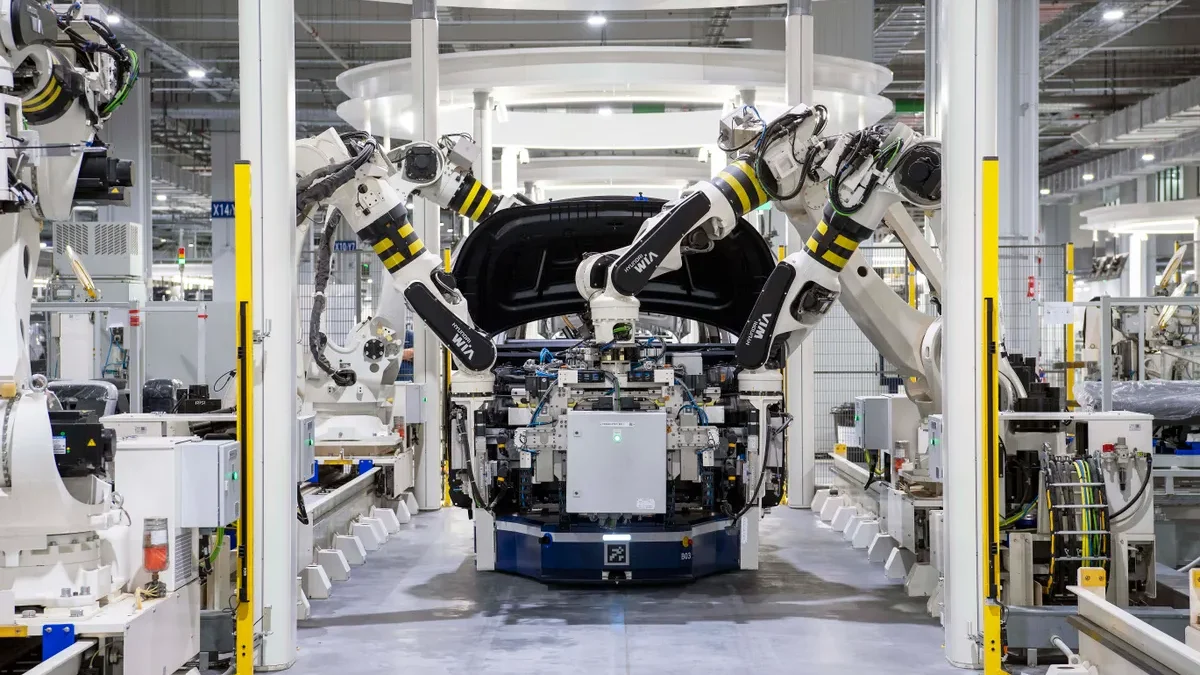
The Xpeng G9L Graz production trial, completed at Magna’s Austrian plant, confirms that what started as a single-model experiment eighteen months ago is fast becoming a structured European manufacturing platform. Four models now roll off the same Graz line, and the commercial logic behind the arrangement is strengthening with each delivery quarter.
The G9L joins the G6, G9, and P7+ as Xpeng’s fourth European-built vehicle, all assembled at Magna’s Graz facility. Assembly in Graz began during the third quarter of 2025, making this Xpeng’s first European manufacturing program. Adding a fourth model within roughly a year is less a milestone than a structural commitment: Graz is no longer a hedging exercise against import tariffs, it is the production spine of Xpeng’s European business.
A pre-production G9L will now drive 1,324 km to Paris, where orders open at the Paris Motor Show premiere on October 12. The car was officially launched in China on September 17, 2026, according to Xpeng’s Q3 2026 delivery announcement, with Paris serving as its global debut, a sequencing that underscores where the brand’s growth ambitions sit.
The G9L arrives with an unusually deep development log: 6.74 million km of testing across 26 markets over three years, including 192 crash tests. Its standard chassis combines dual-chamber air suspension, variable damping, and rear-wheel steering with up to 15 degrees of articulation, specifications calibrated for European road and regulatory standards rather than retrofitted from a China-only brief.
The commercial context behind this expansion is now hard to dismiss. Xpeng has handed over more than 100,000 vehicles in overseas markets, with more than 60,000 of those in Europe. Quarterly overseas deliveries first cleared 20,000 units in the April-to-June 2026 period, up 81% year on year. Those markets contributed 25% of first-half revenue at an average selling price above €40,000 ($44,800), a figure that matters for margin because it sits well above the price points where Chinese EV tariff debates tend to concentrate.
France alone has absorbed more than 6,000 Xpeng vehicles since the company entered that market two years ago, according to the Xpeng pressroom. That is a modest absolute number but a meaningful proof-of-concept for premium pricing in a market where European legacy brands still dominate consumer preference.
Globally, Xpeng delivered 118,390 vehicles in the third quarter of 2026, a 15% increase over the prior quarter, with September alone reaching 41,256 units, per the Q3 delivery announcement. Overseas volumes in full-year 2025 reached approximately 45,000 units, and Yahoo Finance reported the company is targeting to double international shipments in 2026, a run-rate the quarterly trajectory suggests is achievable if momentum holds.
Zhang Li, Vice President of Global Manufacturing at Xpeng, framed the milestone as a transition in kind, not just in scale: “The latest production milestone represents an important step in our journey from entering Europe to building for Europe. By combining global vehicle development and AI technology with established local manufacturing expertise, we are bringing the next-gen Xpeng vehicles closer to customers in Europe and around the world.”
The hardware is ready; the software is not, at least not for Europe. Xpeng’s advanced driver-assistance system, VLA 2.0, is targeting regulatory approval in Europe in the first half of 2027, after which overseas deliveries to users of that system would begin, according to Xpeng’s IR release. Until that approval lands, European buyers receive the hardware but not the full ADAS feature set that differentiates Xpeng in China.
That gap matters competitively. The G9L is planned for 64 countries and regions, and at an ASP above €40,000, buyers in those markets will benchmark it against vehicles where the full software stack is already live. The Graz line de-risks the logistics and tariff exposure; VLA 2.0 approval is what converts the European platform from a distribution play into a genuine technology sale.
The bull case is straightforward: four models on one contract line, volume doubling year on year, premium pricing holding. The risk is that the ADAS approval timeline slips past H1 2027, leaving Xpeng competing in Europe on hardware alone against rivals whose software differentiators are already certified. That approval date is the single variable most worth watching from here.
Levi Strauss (LEVI) lifted its full-year profit guidance after pocketing a substantial tariff refund in its fiscal third...

Mazda microalgae biodiesel has cleared its first institutional hurdle: Japan’s New Energy and Industrial Technology Development Organization (NEDO)...

India’s military transport aircraft competition, a $10.5 billion procurement for 60 medium transports for the Indian Air Force...