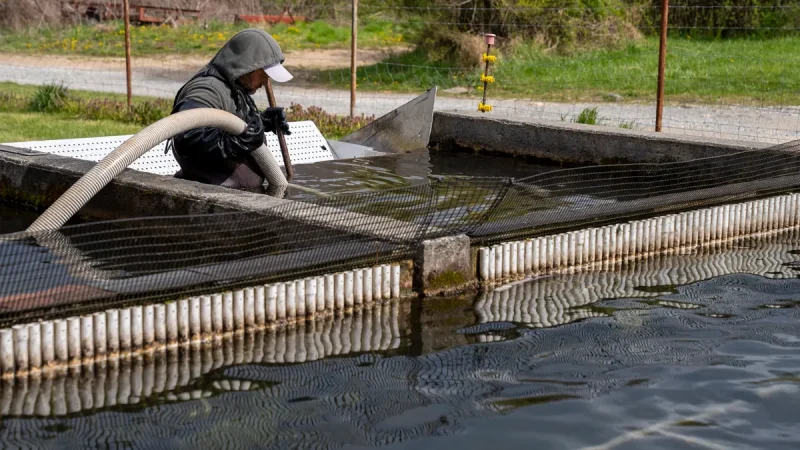
Mazda Microalgae Biodiesel Gets NEDO Backing, but Scale Is the Test
Mazda microalgae biodiesel has cleared its first institutional hurdle: Japan’s New Energy and Industrial Technology Development Organization (NEDO)...

Levi Strauss (LEVI) lifted its full-year profit guidance after pocketing a substantial tariff refund in its fiscal third quarter, but the upgrade is largely a one-time accounting event. The revenue guide actually got trimmed, and a soft direct-to-consumer quarter is the more lasting signal investors need to weigh.
The company raised its full-year adjusted earnings per share outlook to $1.54 to $1.56, up from the prior range of $1.46 to $1.52, according to the Levi Strauss Q3 2026 press release. The midpoint lands inside the analyst consensus range of $1.52 to $1.59 tracked by LSEG, but not at the top of it.
The driver is a tariff refund, not underlying business momentum. Levi recorded approximately $79 million of International Emergency Economic Powers Act refunds in cost of goods sold plus $5 million of related interest income, partially offset by a $20 million tax expense, per the company’s Q3 2026 investor release. That netted to a 16-cent per-share benefit.
Of that 16 cents, Levi redeployed 5 cents back into the business. The company incurred an additional $25 million of expense in the quarter, with $19 million hitting gross margin and $6 million landing in selling, general, and administrative costs, to fund incremental marketing, enhanced supply chain capabilities, and related growth investments. CEO Michelle Gass told analysts on the earnings call that the spending is targeting marketing and promotions for the holiday season.
On the margin line, the result was genuinely strong. According to StreetAccount, Q3 gross margin of 61.7% beat the analyst consensus of 60.7%, expanding 1.1 percentage points from 60.6% in the year-ago quarter. Operating margin hit 13.8% versus 10.8% a year earlier, with tariff refunds contributing 4.9 percentage points of that improvement.
The full-year adjusted EBIT margin guidance was raised to approximately 12.1%, slightly above prior guidance, per an Investing.com transcript of the Q3 2026 earnings call. Full-year organic revenue growth is now guided at approximately 6%, at the high end of prior expectations.
The catch: the full-year EPS guidance already absorbs an approximately $0.04 headwind from a higher tax rate of approximately 23%, two percentage points above last year. Strip out the refund and that tax drag, and the operational earnings picture is narrower than the headline range implies.
Full-year net revenue growth guidance was cut to 7%, the low end of the previous 7% to 7.5% range. Total Q3 net revenues rose approximately 4% to $1.61 billion from $1.54 billion a year ago. In the Americas, revenues grew 4%, but U.S. revenues fell 1%.
Direct-to-consumer net revenues increased 2% in the quarter, but comparable sales were roughly flat. DTC represented 45% of total net revenue for the period. Wholesale, by contrast, grew 6%. “While we delivered strong results across much of the business, our DTC performance fell short of our expectations during the quarter,” Gass said on the analyst call. The company said it has already taken targeted actions to address the shortfall.
Net income for the quarter ending August 30 came in at $168.6 million, or 43 cents per share, down from $218.1 million, or 55 cents per share, in the same period last year. The year-over-year decline reflects the absence of favorable items that lifted the prior year’s net income above this year’s tariff-boosted result.
For Q4, the Q3 2026 earnings call disclosed guidance for reported revenue growth of approximately 3%, organic growth of approximately 4%, an adjusted EBIT margin of 11.4% to 11.6%, and adjusted diluted EPS of $0.36 to $0.38. Embedded in that guidance is approximately 180 basis points of net redeployment cost drag within the EBIT margin range and roughly $0.07 of net redeployment impact on EPS, meaning the holiday quarter carries the bill for the marketing spend Gass announced this quarter.
For context, Levi’s fiscal 2025 Form 10-K shows full-year adjusted diluted EPS of $1.34, up from $1.24 in fiscal 2024. The fiscal 2026 midpoint guidance of $1.55 represents continued progress, but the full-year gross margin guidance assumes U.S. tariffs on China imports hold at 30% and rest-of-world duties stay at 20% for the remainder of the year. If those rates move, the math changes.
Shares were roughly flat in extended trading, which is the right read. The profit upgrade is real but not repeatable. The question for LEVI from here is whether the holiday DTC rebound materializes: if comparable sales recover in Q4, the revenue guide proves conservative. If they do not, the tariff windfall will have papered over a structural soft spot in the company’s highest-margin channel.
Mazda microalgae biodiesel has cleared its first institutional hurdle: Japan’s New Energy and Industrial Technology Development Organization (NEDO)...

India’s military transport aircraft competition, a $10.5 billion procurement for 60 medium transports for the Indian Air Force...

The Forvia Anand India seating joint venture, announced October 7, 2026, is the clearest sign yet that even...