Xpeng G9L Graz Production Advances as Fourth Magna-Built Model
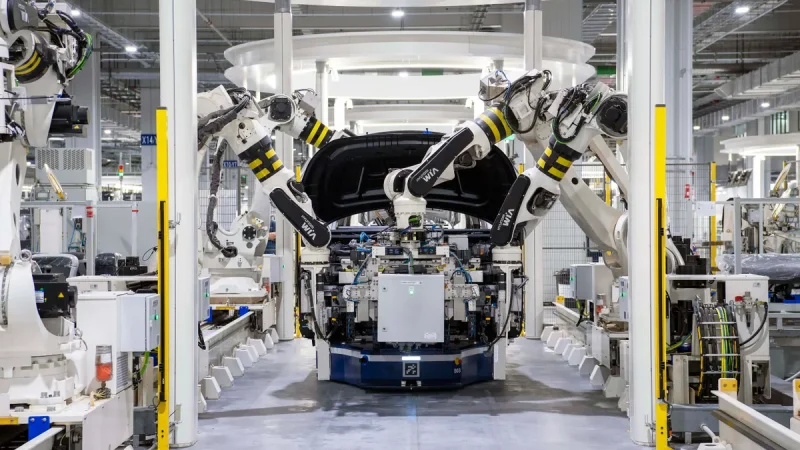
The Xpeng G9L Graz production trial, completed at Magna’s Austrian plant, confirms that what started as a single-model...
The PepsiCo (PEP) North America turnaround is taking longer than the company or Wall Street wants, and Thursday’s third-quarter results made that cost explicit: management cut its full-year earnings growth forecast by roughly half. International markets are doing the heavy lifting, but they cannot fully offset a domestic business that is still shrinking in volume.
PepsiCo reported Q3 2026 adjusted earnings of $2.34 per share, clearing the LSEG analyst consensus of $2.29 per share, according to Yahoo Finance/Quartz. Net sales rose 5.6% to $25.27 billion, ahead of the $24.96 billion consensus. Organic revenue grew 3.1%, the company’s strongest organic growth since Q4 2023, per Globe and Mail/Zacks analysis.
The quarterly beat did not stop management from lowering the full-year outlook. PepsiCo now expects core earnings per share to grow 2.5% to 3.5%, down from its prior projection at the low end of 5% to 7%. For context, PepsiCo’s original 2026 guidance, issued in 2025, had called for core EPS growth of approximately 5% to 7%, as the company disclosed in its preliminary 2026 outlook. The guidance has now been cut twice. On revenue, the company projects net revenue growth of about 6%, at the high end of its prior range of 4% to 6%.
Shares fell less than 1% in premarket trading. The muted reaction reflects the complexity here: the quarter itself was fine; the problem is the direction of domestic earnings power.
The operating margin story cuts both ways. Q3 2026 reported operating profit reached $4.260 billion, for an operating margin of 16.9%, up 195 basis points from 14.9% in Q3 2025, according to PepsiCo’s Q3 2026 SEC 8-K filing. Year-to-date operating margin expanded 440 basis points to 16.7%.
The bull read: strong year-over-year operating leverage. The catch: on a core basis, which strips out restructuring and other items, Q3 core operating margin was also 16.9% but down 35 basis points from 17.3% a year ago. The same SEC filing shows year-to-date core operating margin at 16.5%, down 25 basis points. Commodity costs are likely part of the pressure in the second half, consistent with management’s plan to raise chip and soda prices in the low-to-mid single digits by end of 2026 or early 2027, after cutting prices on brands including Lay’s and Doritos by as much as 15% in February to stimulate volume, per Yahoo Finance/Quartz. That pricing reversal is a bet that consumers will absorb the increase; it is not yet proven.
The North American picture is straightforward and not good. The North American beverage unit saw volume shrink 2% in the quarter. The food division was flat. CFO Steve Schmitt acknowledged in prepared remarks that the domestic turnaround is moving more slowly than expected.
CEO Ramon Laguarta offered some forward-looking color. The North American convenient foods segment (which includes Doritos and Quaker Oats) saw organic revenue improve sequentially. The beverage unit saw organic volume trends pick up, driven by functional hydration and zero-sugar drinks. But carbonated soft drinks lagged the broader category, including rival Coca-Cola.
International operations remain the counterweight. PepsiCo’s international business accounted for 41% of net revenue year-to-date, Laguarta noted in prepared remarks. Volume grew in all but one international unit, only the EMEA convenient foods division posted a volume decline, of 1%. Year-to-date net revenue of $68.898 billion was up 6.7% from $64.582 billion in the comparable prior-year period, per the Q3 2026 earnings release, with year-to-date organic revenue up 2.7%.
The fix strategy centers on product innovation (simpler ingredients, protein and fiber claims, functional hydration, zero-sugar), increased marketing spend, and planned cost reductions to eliminate redundancies. Laguarta also pointed to early sequential improvement as evidence that the strategy is gaining traction.
The evidence leans toward cautious patience rather than either alarm or confidence. North American volumes are still negative or flat, pricing power is being rebuilt rather than assumed, and a second guidance cut in a single year creates credibility risk heading into Q4. The test is whether the sequential organic revenue improvement in convenient foods and beverage volumes accelerates, or whether Q4 delivers a third revision.
The Xpeng G9L Graz production trial, completed at Magna’s Austrian plant, confirms that what started as a single-model...

Levi Strauss (LEVI) lifted its full-year profit guidance after pocketing a substantial tariff refund in its fiscal third...
Mazda microalgae biodiesel has cleared its first institutional hurdle: Japan’s New Energy and Industrial Technology Development Organization (NEDO)...