USS Truman RCOH Contract Hands HII a $5.1B Revenue Anchor

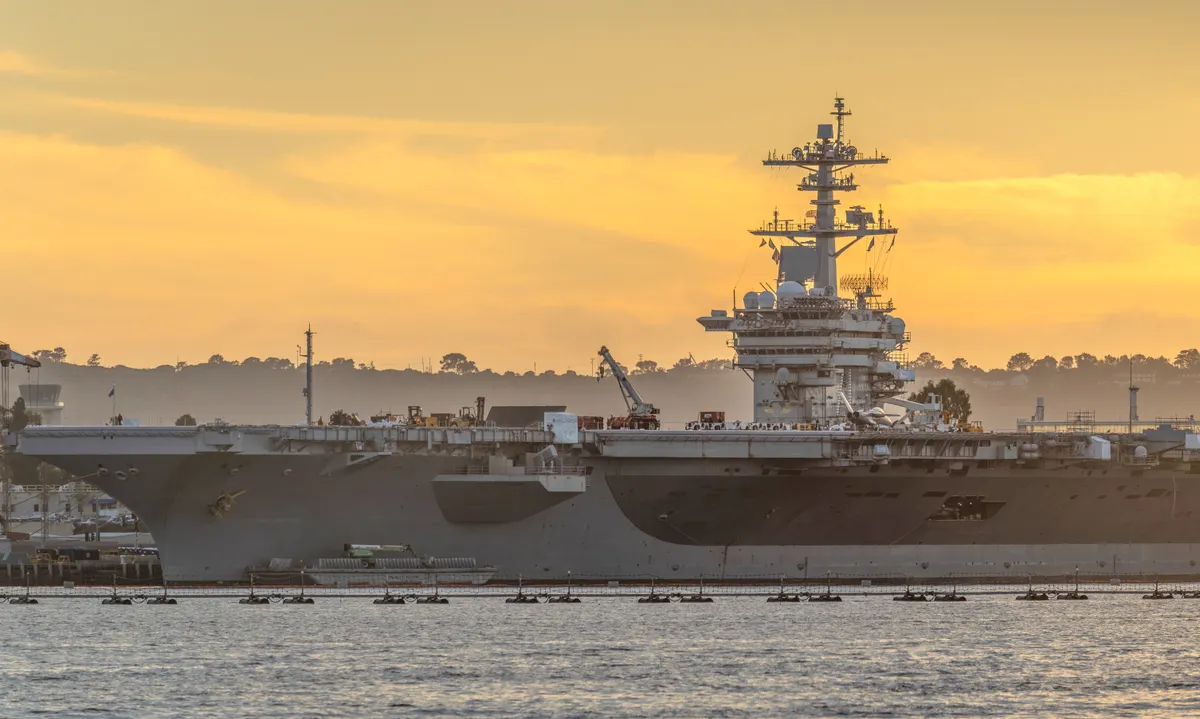
The USS Truman RCOH contract awarded to HII (HII) locks in one of the most predictable revenue streams available in defense shipbuilding: a fixed-price, multi-year overhaul with no competitor and no cancellation risk short of an act of Congress. The Pentagon on Tuesday awarded HII a fixed-ceiling incentive contract worth $5,099,973,132 to execute the refueling and complex overhaul (RCOH) of USS Harry S. Truman (CVN-75) at Newport News Shipbuilding in Virginia, with options that could raise the cumulative value to $5,183,380,744, according to the HII newsroom.
The work is expected to be complete by November 2031, giving HII roughly six years of contracted backlog on a single hull.
What the USS Truman RCOH Contract Means for HII’s Backlog
Only $547,826,087 in FY2026 Shipbuilding and Conversion, Navy funds were obligated at award, roughly 10.74% of the base contract, according to the U.S. Navy press release. That leaves approximately $4,552,147,045 to be drawn down over the life of the program, a steady funding pipeline rather than a single-year spike.
The contract carries a fixed-ceiling incentive structure, which the Navy designed to reward schedule performance and distribute cost risk between HII and the government. For HII investors, that framing matters: the incentive component means upside exists if Newport News delivers ahead of schedule, but the fixed ceiling caps the Navy’s exposure if costs run over, putting more of any overrun risk on HII.
The RCOH is a once-in-a-carrier-lifetime maintenance event, occurring at the midpoint of each Nimitz-class carrier’s 50-year service life, per Inside Defense. Truman was delivered to the Navy in 1998, placing it squarely at that midpoint now. On completion, the Navy says Truman will redeploy as the most technologically advanced Nimitz-class carrier in the fleet.
The contract also carries a structural distinction worth noting. Per the Navy’s print release, it is the first CVN RCOH contract awarded since the standup of Portfolio Acquisition Executive (PAE) Maritime, a procurement office reorganization the Navy intends as a model for future major shipbuilding awards. The Truman overhaul is, in part, a test case for the new acquisition structure.
Scope, Timeline, and the Truman’s Complicated Record
The work itself is extensive. HII’s scope covers refueling the ship’s two nuclear reactors, modernization across thousands of compartments and tanks, upgrades to propulsion plant systems, and combat-systems improvements. Bryan Caccavale, Newport News Shipbuilding’s vice president of program management, said in an HII release: “When the ship arrives at NNS, we’ll apply that same diligence to working with our suppliers and Navy partners to ensure a successful recapitalization of CVN 75.”
Truman’s Smart Start period began in November 2025, with the ship and crew preparing for the multi-year effort before physically departing Naval Station Norfolk for Newport News. The carrier will be the eighth Nimitz-class ship to complete its RCOH at that yard.
The vessel arriving for overhaul carries a complicated operational record. Truman completed a 251-day deployment during which it fired over 1.1 million pounds of ordnance and conducted what the Navy described as the largest carrier-launched airstrike in history. That same deployment included a collision with the merchant vessel Besiktas-M near Port Said in February 2025, the relief of the ship’s commanding officer, and the loss of three F/A-18 Super Hornets to separate incidents including a friendly-fire shootdown by USS Gettysburg.
Those incidents do not affect the contract economics directly, but they reinforce why the RCOH scope is extensive: the ship carried its systems hard, and the overhaul will need to address wear beyond a standard maintenance cycle.
The bull case on HII here is straightforward: a sole-source, government-funded contract worth over $5 billion with six years of execution runway and a schedule-incentive upside. The bear case is the fixed ceiling. Newport News is already managing a congested workload across the carrier and submarine programs, and if labor or supply-chain costs exceed projections, HII absorbs the overage. The precedent from prior Nimitz-class RCOHs matters: schedule slippage on these programs is common, and the incentive structure only pays out if HII beats the timeline. The key variable from here is whether the new PAE Maritime acquisition framework tightens that discipline or simply rebrands the existing risk allocation.