Raytheon’s $20.7B AMRAAM Contract Is a Bet on Arsenal of Freedom

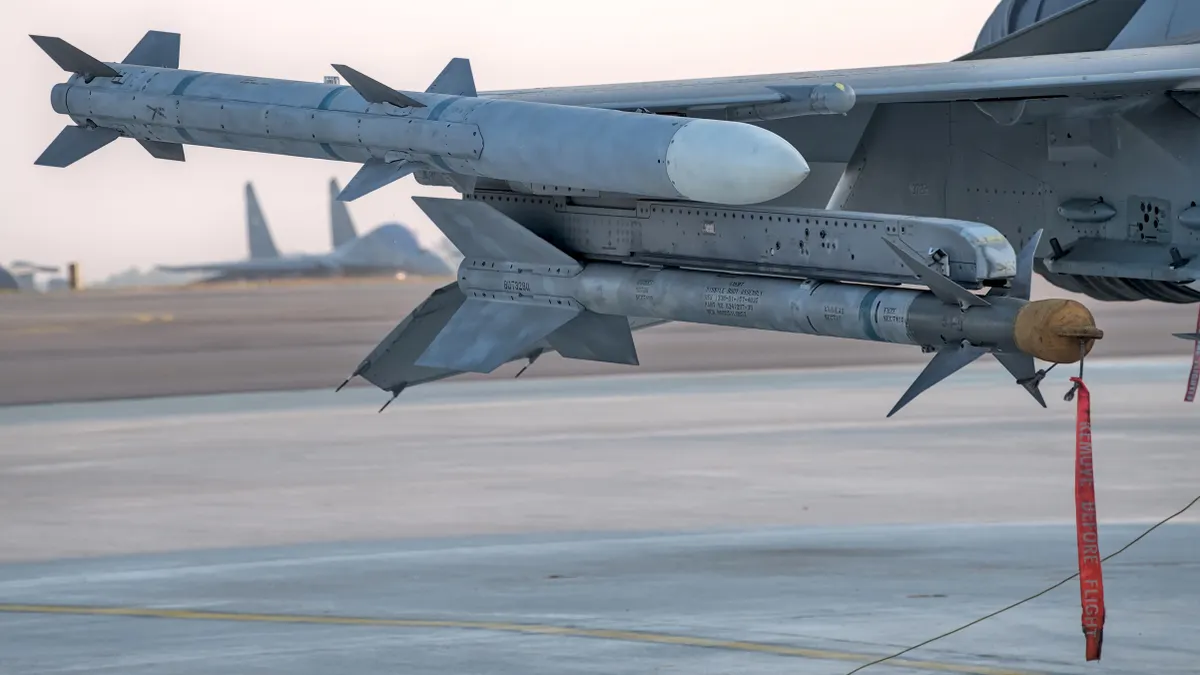
Raytheon’s AMRAAM contract with the Pentagon, worth up to $20.7 billion over five years, is the largest single award in the missile program’s history and frames RTX (RTX) as the central beneficiary of the Defense Department’s push to rebuild munitions stockpiles. The bull case writes itself. The catch is that Congress has not yet funded the full deal, which means the ceiling figure is provisional until lawmakers act.
A Contract That Dwarfs Everything That Came Before
The scale here is hard to overstate. The Pentagon’s previous record AMRAAM award was a $3.5 billion contract issued in July 2025, covering missiles for the Air Force, the Navy, and allies in Europe, Asia, and the Middle East. The new award is roughly six times that figure. For context, a June 2023 single-lot contract for AMRAAM Production Lot 37, awarded on a firm-fixed-price basis, came to just over $1.15 billion, according to the Pentagon contracts page. The step-change in contract scale reflects a deliberate policy shift, not just organic demand growth.
The five-year deal includes two option years and is structured as a joint buy by the Air Force, the Navy, and allied nations. RTX and the Pentagon announced the award together, though the department noted it was formally awarded September 25. Under Secretary of Defense Michael Duffey called it part of the Pentagon’s Arsenal of Freedom campaign to ramp production across the defense industry.
The Raytheon AMRAAM contract fits a broader procurement pattern. Reuters reported that the award mirrors the structure of a $58.6 billion Patriot interceptor deal awarded to Lockheed Martin in July, a seven-year procurement plan running through fiscal 2032. The Pentagon is building long-duration, high-ceiling contracts across its air-defense and precision-strike portfolios, not one-off buys.
What the Raytheon AMRAAM Contract Signals for RTX’s Production Trajectory
RTX said the company nearly doubled production of AMRAAM and other munitions in 2025 compared with 2024 and is now exploring international co-production arrangements. In February, Raytheon signed five framework agreements with the Pentagon committing to raise annual output to at least 1,900 AMRAAMs, more than 1,000 Tomahawks, and more than 500 Standard Missile-6 interceptors. Those targets predated this contract; the new award gives the production commitment a formal funding vehicle, provided Congress follows through.
AMRAAM’s demand profile has two distinct pressure points. Stockpiles were drawn down first by the war in Ukraine, then compounded by U.S. military use of munitions during its own operations against Iran, according to Reuters. That dual drawdown explains why the Pentagon accelerated from a $3.5 billion single-lot contract to a $20.7 billion multiyear framework inside of one year.
Raytheon President Phil Jasper said in a statement that the company continues to invest in its workforce, supply chain, and facilities to “rapidly scale production capacity and meet surging demand” from the Air Force, Navy, and international customers. That language is consistent with RTX’s capital-allocation posture, but the limiting variable is not ambition: it is whether the supply chain can keep pace. Industry executives have warned, as Reuters reported, that defense contractors may hold back major investments in parts and factories until Congress actually appropriates the money.
The Pentagon acknowledged the dependency directly, thanking Congress for multiyear procurement authority and saying it hopes lawmakers will provide more authority and funding to sustain production. That is diplomatic language for a real structural risk: a contract ceiling is not the same as funded orders.
There is also a successor program to track. The Pentagon signed a separate framework deal with Lockheed Martin earlier this month to boost production of the AIM-260 Joint Advanced Tactical Missile, which is being developed to outrange and eventually replace AMRAAM. That program does not threaten RTX’s near-term revenue, since AMRAAM remains the primary interceptor for the National Advanced Surface-to-Air Missile System and is fielded by 44 countries. Over a longer horizon, though, Lockheed’s role in the successor system is a ceiling on how long Raytheon owns this franchise outright.
The bull read: RTX holds the dominant position in a missile category the U.S. and its allies are committed to scaling aggressively, and a $20.7 billion ceiling gives management a credible multi-year production plan to fund capital investment. The bear read: the contract is provisional, Congress has not appropriated the full amount, and production constraints in the supply chain could delay revenue recognition even after funding arrives. Which side prevails depends almost entirely on what appropriators do next, making the Pentagon’s own call to Congress the most consequential near-term catalyst for this trade.