Boeing Lands $2.38B F-15EX Lot 7 Contract for 22 Eagle IIs

The U.S. Air Force awarded the F-15EX Lot 7 contract to Boeing on September 29, 2026, covering 22 aircraft at a price of $2.38 billion. The deal keeps the Eagle II production line intact through 120 total aircraft under contract, but the per-unit math tells a more complicated story about where this program is heading.
Deadline Money and What It Bought
The funding came from the FY 2026 budget and the reconciliation package known as the One Big Beautiful Bill, which carried a hard condition: spend the appropriated dollars before the fiscal year closes September 30 or lose them. That deadline shaped the structure of the award as much as any procurement strategy did.
Brig. Gen. Timothy Helfrich, portfolio acquisition executive for the Fighters and Advanced Aircraft Directorate, described the logic plainly. “Lot 7 reflects a disciplined approach to executing available resources while balancing the realities affecting defense production,” he said, adding that the team “remained focused on affordability, production continuity and delivering the aircraft needed to modernize the U.S. Air Force’s fighter fleet for the threats we face today and into the future.”
The release also flagged that the F-15EX Lot 7 contract accounts for 2025 production disruptions and inflation across the defense industrial base. Those two factors, bundled under the phrase “current programmatic realities,” are the polite version of a cost explanation. The Air Force chose not to disclose the contract value in its own release; Boeing disclosed the $2.38 billion figure separately.
What the F-15EX Lot 7 Contract Signals on Unit Cost
The per-unit arithmetic across recent lots puts the pressure in context. According to the DoD Comptroller’s FY 2025 Weapons budget document, Boeing’s St. Louis facility received $1,808.5 million for 18 aircraft in FY 2025 procurement funding, excluding modifications, which works out to roughly $100.5 million per jet. The DoD Comptroller’s FY 2026 Budget Request Overview Book sought $3.1 billion for 21 aircraft, implying roughly $148 million per aircraft at the request stage. Lot 7 prices 22 aircraft at $2.38 billion, or approximately $108 million per jet.
The FY 2026 request figure is the one that demands attention. The budget ask for 21 aircraft came in at $3.1 billion; the Air Force ultimately contracted 22 aircraft for $2.38 billion. One more jet, $720 million less. The gap between the request and the final award likely reflects a mix of negotiating dynamics, the use of previously available reconciliation funds at fixed appropriations levels, and the production-disruption adjustments Helfrich referenced. It also means the FY 2026 request quantity of 21 differs from the 22 actually awarded under Lot 7, a discrepancy the DoD budget documents do not resolve.
A DoD background briefing on the FY 2026 defense budget described the F-15EX as complementary to stealth fighters, leveraging superior payload capacity and long-range capabilities, with the budget request framed around preserving industrial base capacity at Boeing’s St. Louis line. Lot 7 delivers on that rationale whether or not the unit price is favorable.
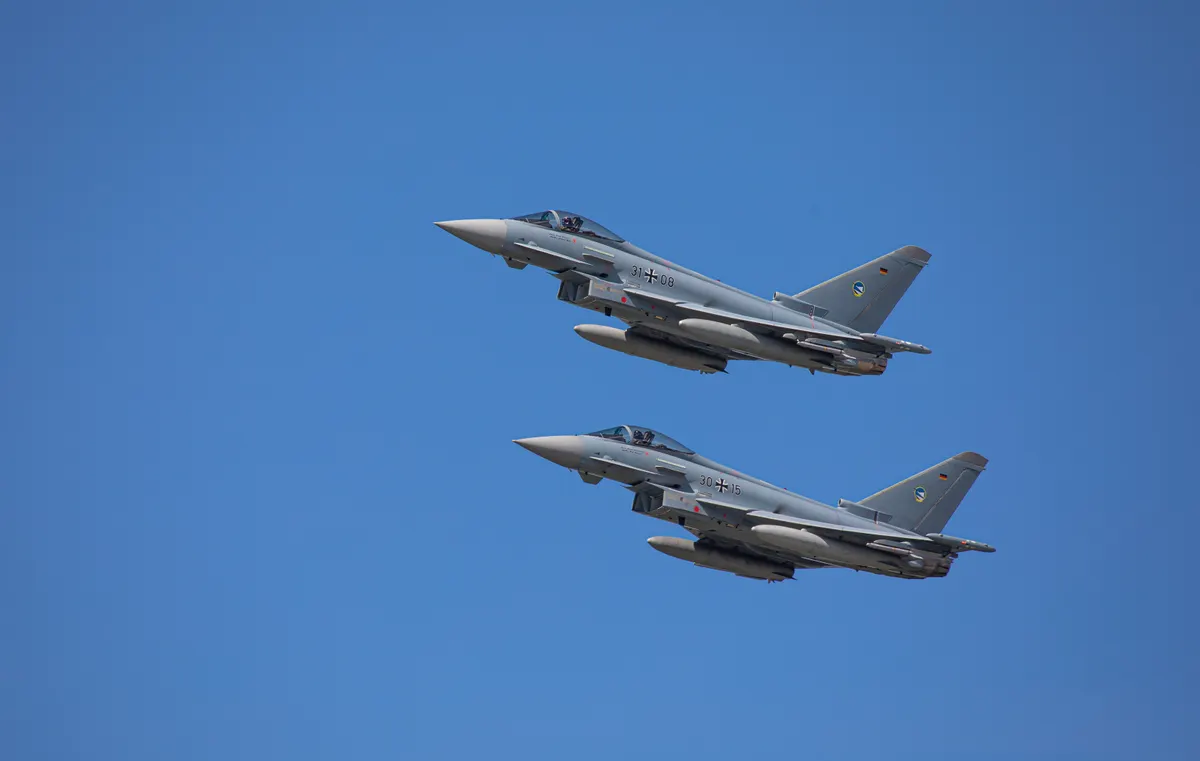
Christina Upah, Boeing’s F-15 program vice president, said the company “is committed to delivering this critically important aircraft to the U.S. Air Force, which will strengthen the nation’s ability to project power and stay ahead of emerging threats around the world.” The photograph released alongside the Boeing announcement shows an F-15EX on the Boeing flight ramp in St. Louis ahead of delivery.
Where the Program Stands and What Comes Next
Boeing is now under contract for Lots 1 through 7, bringing the total F-15EX fleet on order to 120 aircraft. The jet is designed to replace the aging F-15C and D variants, equipped with advanced avionics, large-area displays, digital backbone architecture, and expanded survivability features. An F-15EX visited Selfridge Air National Guard Base in Michigan in June 2025 as part of basing preparations at the 127th Wing, indicating the operational pipeline is already moving.
The bull case here is straightforward: the production line is continuous, the congressional funding mechanism worked, and 120 aircraft under contract provides Boeing’s St. Louis workforce and its supplier chain with genuine runway. The Air Force also structured Lot 7 to incorporate an F-15 negotiation team, a step the release says is consistent with the Pentagon’s acquisition transformation priorities, which at minimum suggests the service is trying to tighten procurement cycles on future lots.
The bear case is the cost trajectory. If inflation and production disruption were baked into Lot 7 pricing and the FY 2026 budget request already implied a unit cost well above the FY 2025 actuals, the pressure on future lot negotiations is real. The F-15EX competes for the same budget lines as next-generation programs. Any further cost growth that pushes per-unit pricing back toward $140-plus million will sharpen that internal competition, and the Air Force has already shown it will not voluntarily disclose the price it agreed to pay.