Toyoda Gosei India Expansion Targets Maharashtra SUV Supply Chain

Toyoda Gosei’s India expansion takes its most direct form yet in Maharashtra: a new plant in Bidkin built to feed a Toyota Kirloskar factory next door. The investment of INR5.76 billion ($65 million) follows the same customer-proximity logic that has defined Japanese supplier strategy in India for decades, but the scale and timing make this one worth examining closely.
The Toyota Kirloskar Anchor
Toyota Kirloskar Motor announced its Bidkin vehicle plant on May 11, 2026, with production targeted for the first half of 2029 and capacity set at 100,000 vehicles per year. The facility, which will employ approximately 2,800 people, is designed to supply both India and surrounding export markets, according to Toyota Motor Corporation. It will produce a new SUV through stamping, welding, painting, and assembly processes.
Toyoda Gosei’s Bidkin plant is timed to match that production ramp almost exactly. The read here is straightforward: the supplier is locking in captive demand before a single Toyota Kirloskar vehicle rolls off the new line. That kind of pre-positioning reduces commercial risk, but it also means Toyoda Gosei’s fortunes in Bidkin are tightly coupled to Toyota Kirloskar’s execution and volume.
Toyoda Gosei India Expansion: What the Plant Actually Does
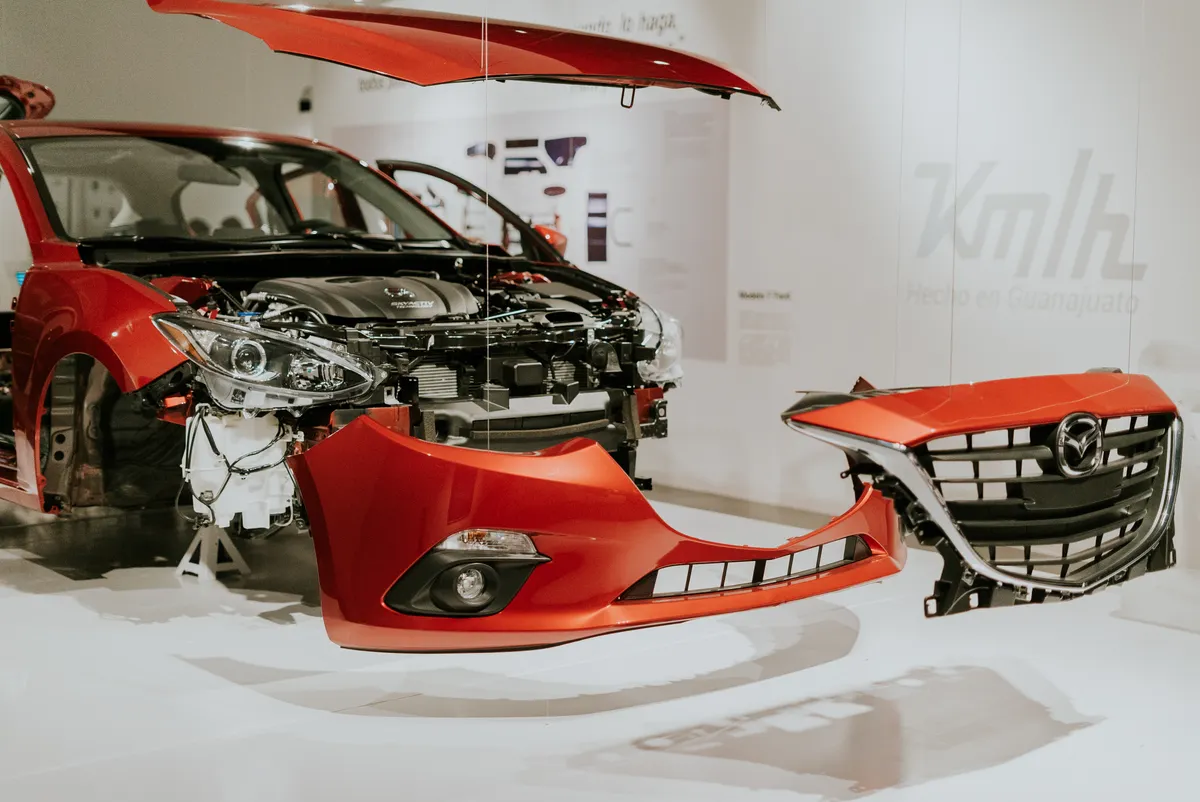
The Bidkin site will occupy around 78,400 square meters and employ approximately 570 people by 2030. Products span bumpers, instrument panels, steering wheels, airbags, and plastic fuel filler pipes, covering both safety-critical components and exterior body parts. That breadth is deliberate: Toyoda Gosei is positioning itself as a multi-system supplier, not a single-component vendor, which raises its value per vehicle and switching costs for the customer.
On the production side, the plant will run large electric injection molding machines with automatic mold changes, a bumper paint booth, and automated guided vehicles. Solar panels and IoT-driven production control feature prominently, reflecting the group’s broader push toward leaner, lower-emission manufacturing. The facility will also deploy what Toyoda Gosei calls “smart automated processes” first developed in Thailand, pairing collaborative robots with karakuri, the traditional Japanese mechanism-based automation method using levers and springs.
Operationally, the Bidkin site will run as a branch of Toyoda Gosei South India, the group’s Karnataka subsidiary. That entity was originally a joint venture called TG Kirloskar Automotive; Toyoda Gosei acquired Kirloskar Systems’ stake in 2015, raising its equity to 95% and taking effective control, with Toyota Tsusho holding the remaining 5%.
Comparing the Footprint
This is Toyoda Gosei’s eighth Indian plant. For context on cadence, the most recent prior opening was the Harohalli, Karnataka facility, a branch of the same South India subsidiary, planned to begin production in January 2026. That plant required an investment of approximately INR2.05 billion, about a third of the Bidkin outlay, with land of roughly 40,000 square meters. Bidkin is nearly double the footprint at 78,400 square meters and carries a capital commitment more than 2.8 times larger. The gap reflects what Toyota Kirloskar’s 100,000-unit SUV plant demands in terms of supplier capacity.
The group’s Indian presence also includes plants structured through Toyoda Gosei Minda India, a joint venture with the Uno Minda Group in Rajasthan, covering a different customer and product base. The multi-entity structure lets Toyoda Gosei serve Maruti Suzuki and other non-Toyota OEMs without forcing all Indian exposure through a single channel.
The Bull and Bear Read
The bull case is India’s SUV volume trajectory. Sport utility vehicles are taking share from compact cars across Indian segments, and Toyota Kirloskar’s new Bidkin plant is sized to capture part of that shift. A supplier positioned inside the same industrial area, producing high-content safety and exterior systems, captures proportionally more revenue per unit than a weatherstrip or rubber parts vendor.
The bear case is concentration. Toyoda Gosei is investing $65 million against a single Toyota Kirloskar ramp. If that plant faces delays, volume shortfalls, or model-cycle disappointment, Bidkin carries under-utilization risk for years. The karakuri-and-cobot automation strategy helps keep variable costs flexible, but the fixed land and tooling commitment is substantial for a plant still two and a half years from first production.
The net judgment leans positive: Toyoda Gosei’s customer is Toyota, the Bidkin plant is Toyota’s own SUV play in one of the world’s fastest-growing auto markets, and the supplier’s multi-system scope gives it real leverage per vehicle. The risk is real but the demand anchor is as solid as a captive Japanese OEM relationship gets.