
Levi Strauss Profit Guidance Climbs on Tariff Refunds, But the Revenue Picture
Levi Strauss (LEVI) lifted its full-year profit guidance after pocketing a substantial tariff refund in its fiscal third...
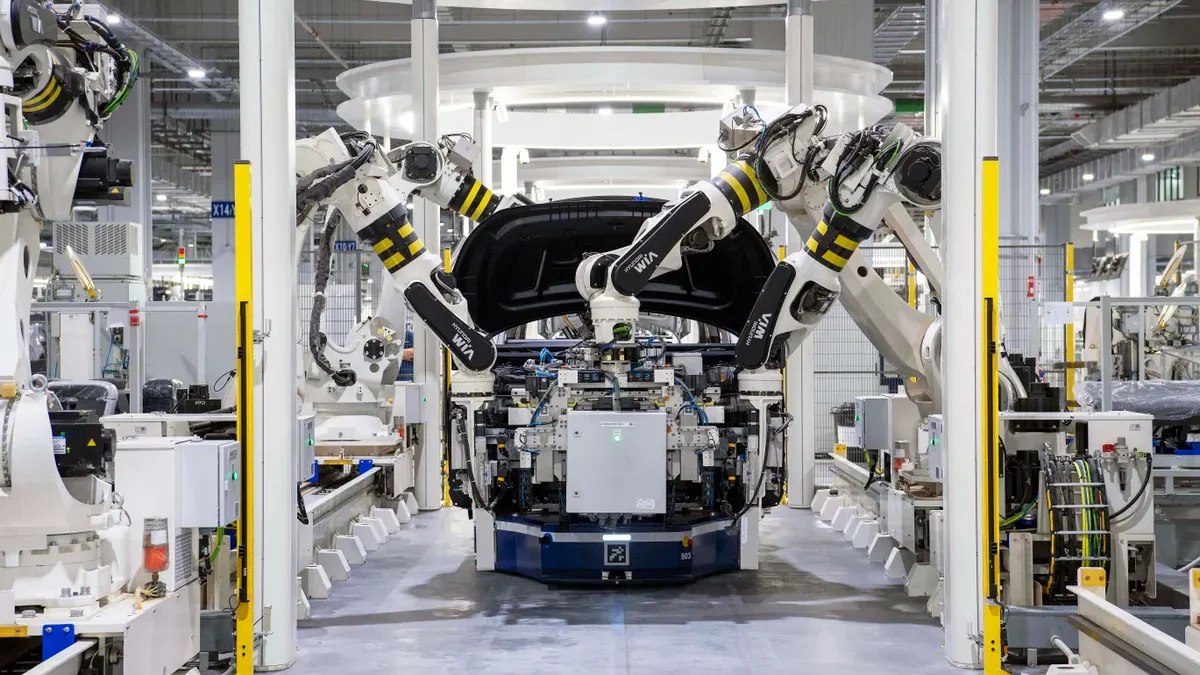
The Volvo Cars EBIT margin target of above 8% is an ambitious number for a company that reported just 3.5% in 2025 and 1.1% as recently as Q2 2026, and the distance between those two data points is the whole story at Tuesday’s Stockholm investor day. Volvo is not hiding the gap; it is betting a 13-model product offensive and a deepened Geely partnership can close it before the market loses patience again.
Context matters here. Automotive World reports that Volvo originally set an 8–10% EBIT margin goal for the mid-decade back in 2021, then lowered it repeatedly before withdrawing financial guidance altogether in 2025, including a prior 2026 full-year target of 7–8% core operating margin and a strong positive free cash flow commitment. Today’s above-8% pledge is, structurally, a re-run of a goal that has already slipped once.
The recent quarterly numbers give the scale of the rebuild required. Volvo Cars’ investor relations data shows an EBIT margin of 1.1% on revenue of SEK 77.7 billion and 171,500 retail units in Q2 2026. The Q1 2026 results were marginally better at 2.2%, with SEK 1.6 billion in EBIT, BEV sales up 14%, and electrified vehicles accounting for 52% of total sales. Neither quarter is remotely close to 8%.
CFO Fredrik Hansson told Reuters ahead of the event that the company is not attaching a timeframe to the new margin goal, but that Geely collaboration and cost cuts are expected to deliver 2–3 percentage points of improvement. That is a meaningful portion of the gap, though it still leaves the remaining lift dependent on the product plan and volume assumptions that analysts at Automotive World have already questioned.
The 13-model lineup splits into two distinct tracks. Seven cars target Western markets on the existing SPA2 and SPA3 architectures, built around the HuginCore computing platform that Volvo’s own press release confirms will underpin its software-defined vehicles. Six models are tailored for China through shared technology with Geely. The dual-track structure is the operational expression of Volvo’s broader thesis: deglobalisation is a permanent feature of the landscape, not a temporary disruption, so building regionally optimised products is more defensible than a single global architecture.
The Geely angle carries the most quantifiable upside. Parts commonality is targeted to rise from 10% to around 30% by 2030, which Volvo says will contribute approximately 5% in material cost savings. As more models migrate to SPA-based or shared hybrid platforms, the company anticipates lower investment per model and improved margins per unit. Volvo’s press release also states that investments in its technology stack and manufacturing are expected to decrease from current levels, which, if delivered, would structurally reduce the capital intensity drag on returns.
The tariff environment adds both urgency and risk to this plan. Reuters reports that Volvo, with most US-bound cars manufactured in Europe, has been heavily exposed to President Donald Trump’s import tariffs, and has taken steps to shift some hybrid production to the United States. That move is reactive rather than strategic, and its cost and timing implications are not yet reflected in margin guidance.
The corporate restructuring is the other lever. Reuters reports that Håkan Samuelsson, brought back as CEO in early 2025 for a two-year term to address a record-low share price, oversaw a cut of 3,000 white-collar jobs as part of the reset. Volvo is also planning to shift from pure vehicle sales toward complete customer offers and to reduce corporate overhead, moves that are standard premium-sector playbook but whose margin contribution depends entirely on execution speed.
The bull case is coherent: Geely synergies, platform consolidation, and cost reductions collectively add 2–3 points, the product offensive drives volume and mix improvement, and a regionalised structure insulates margins from further tariff escalation. The bear case is that Volvo has set and missed this exact target before, the current margin baseline of roughly 2% leaves almost no room for execution error, and the CFO has explicitly declined to put a date on delivery. Samuelsson put it plainly at the event: “With a regionally optimised product portfolio, unique synergies, electrification and new levels of efficiency, we will build a company capable of reaching beyond 8% EBIT margins.” The word “capable” is doing a lot of work in that sentence.
The clearest near-term test is whether parts commonality gains show up in gross margin by mid-2027. If they do not, the above-8% target will face the same credibility erosion that forced guidance withdrawal in 2025.
Levi Strauss (LEVI) lifted its full-year profit guidance after pocketing a substantial tariff refund in its fiscal third...

Mazda microalgae biodiesel has cleared its first institutional hurdle: Japan’s New Energy and Industrial Technology Development Organization (NEDO)...

India’s military transport aircraft competition, a $10.5 billion procurement for 60 medium transports for the Indian Air Force...