
Levi Strauss Profit Guidance Climbs on Tariff Refunds, But the Revenue Picture
Levi Strauss (LEVI) lifted its full-year profit guidance after pocketing a substantial tariff refund in its fiscal third...
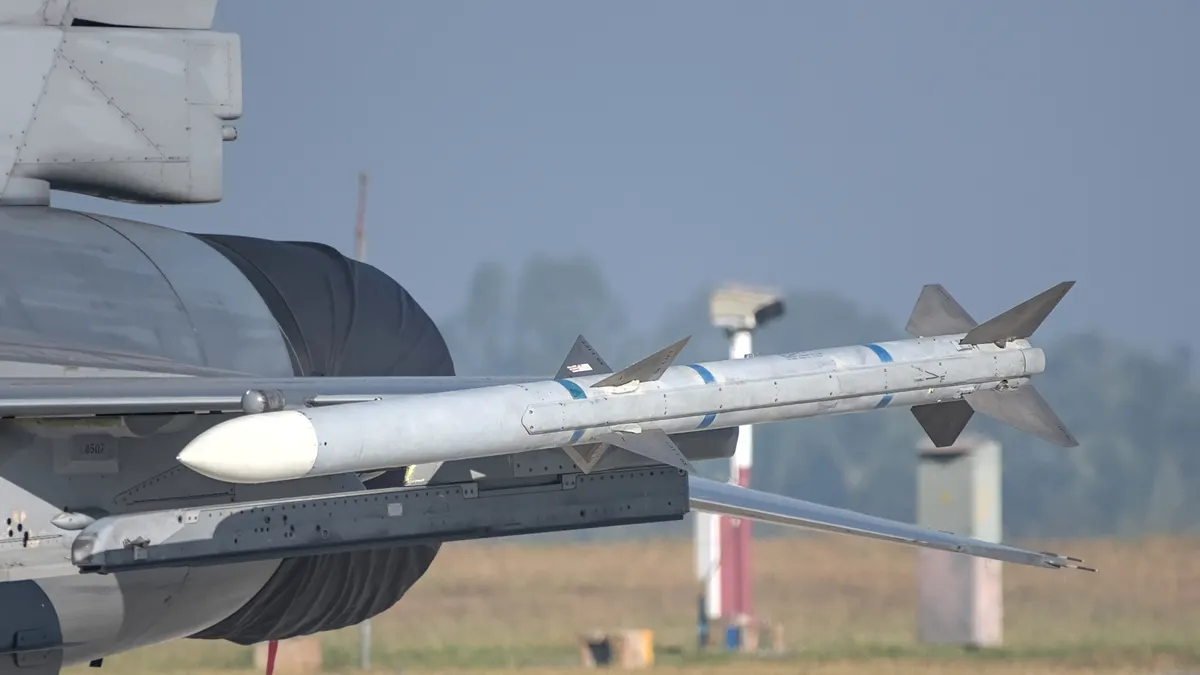
The Pentagon and Lockheed Martin have taken a concrete step toward scaling AIM-260 JATM production, signing a framework agreement that functions as an official demand signal rather than a purchase order. The agreement carries no dollar value and no production targets, but it unlocks something equally consequential: Lockheed has committed to spending its own money to expand capacity now, ahead of any formal multiyear contract.
For investors in Lockheed Martin (LMT), the read here is straightforward. This is not revenue today. It is a capacity bet that positions LMT’s Missiles and Fire Control segment to absorb a large, sustained order when Congress authorizes and funds a multiyear buy. The bull case rests on the probability of that authorization. The bear case is that it stalls.
The framework, described in the Department of War press release as establishing a path for future Multi-Year Procurement of JATM, is not operating in a vacuum. According to Air and Space Forces Magazine, the Air Force’s fiscal year 2026 budget request disclosed that 144 JATMs were bought across 2024 and 2025, with at least another 112 planned. The fiscal year 2027 request, still before Congress, includes $1.5 billion in procurement funding to scale output, though no quantities are listed in the budget documents.
That $1.5 billion figure is the key number to watch. If Congress passes it, the manufacturing ramp this framework is designed to enable becomes a funded reality. If it gets cut or delayed, Lockheed is absorbing capacity investment costs against uncertain future returns.
Under Secretary of Defense for Acquisition and Sustainment Michael Duffey, who assumed the role on June 5, 2025, framed the agreement in the language of industrial readiness: “Speed, scale, and stability drive acquisition excellence, and these gears must turn in unison.” Tim Cahill, president of Lockheed Martin Missiles and Fire Control, was direct about the financial commitment: “We’re proud to finally talk about the extraordinary work behind this missile and how we’re working with the U.S. government to rapidly scale production.”
The framework explicitly covers foreign military sales alongside domestic procurement, and the Australia deal is the only concrete export order on the table. On Aug. 6, Australia announced it would invest approximately $520 million USD ($736 million AU) for JATM for the Royal Australian Air Force, becoming the missile’s first export customer.
The approved potential sale, however, is considerably larger. The Congressional Record shows Congress was notified of the sale on January 28, 2026, for defense articles and services estimated at $3.16 billion. The Federal Register arms-sales notification (Transmittal No. 26-03) breaks that total into $2.61 billion in Major Defense Equipment and $0.55 billion in other items, covering up to 450 AIM-260 JATMs, up to 5 Integration Test Vehicles, and up to 30 Guided Test Vehicles, plus support equipment and services.
Australia plans to integrate JATM first on F/A-18F Super Hornets, then on F-35A Lightning IIs and EA-18G Growlers. According to Breaking Defense, Australia’s Department of Defence has stated the missile will provide a credible deterrent against airborne targets and deepen interoperability with the United States. The MQ-28 Ghost Bat drone, early variants of which can already fire the AIM-120 AMRAAM, is a potential future integration platform.
The gap between Australia’s $520 million commitment and the $3.16 billion approved ceiling is worth noting. The approved package sets the upper bound for what Washington has authorized Canberra to purchase. How much of that ceiling Australia eventually draws down will influence JATM production volumes and, in turn, the economics of the U.S. multiyear buy.
The agreement’s silence on production rates and dollar value is not an accident. The JATM program remains classified, and as Breaking Defense reported, the announcement included no information on the scale or timeline for the ramp-up. That opacity cuts both ways. It limits the market’s ability to underwrite the growth story with precision, but it also shields the program from competitive exposure.
The missile’s design parameters illustrate why the Pentagon treats this as a priority. Sized to fit the internal bays of fifth-generation fighters like the F-22 and F-35, JATM must outrange current U.S. air-to-air weapons, with public estimates placing its reach at more than 120 miles, a direct counter to China’s PL-15. It is built to replace the AIM-120 AMRAAM across both Air Force and Navy platforms.
The first public images of the weapon appeared after aviation photographer Jonathan Tweedy photographed an AIM-260 on a Navy F/A-18F Super Hornet at Eglin Air Force Base, Florida, on May 13. The Aviationist published the photos two days later.
The investment thesis for LMT on JATM hinges on one event: Congress funding the $1.5 billion FY2027 procurement request. Passage converts this framework from a capacity placeholder into a revenue-generating multiyear contract. Failure or delay leaves Lockheed carrying self-funded expansion costs against an uncertain order book. Watch the defense appropriations process; that is where this story resolves.
Levi Strauss (LEVI) lifted its full-year profit guidance after pocketing a substantial tariff refund in its fiscal third...

Mazda microalgae biodiesel has cleared its first institutional hurdle: Japan’s New Energy and Industrial Technology Development Organization (NEDO)...

India’s military transport aircraft competition, a $10.5 billion procurement for 60 medium transports for the Indian Air Force...