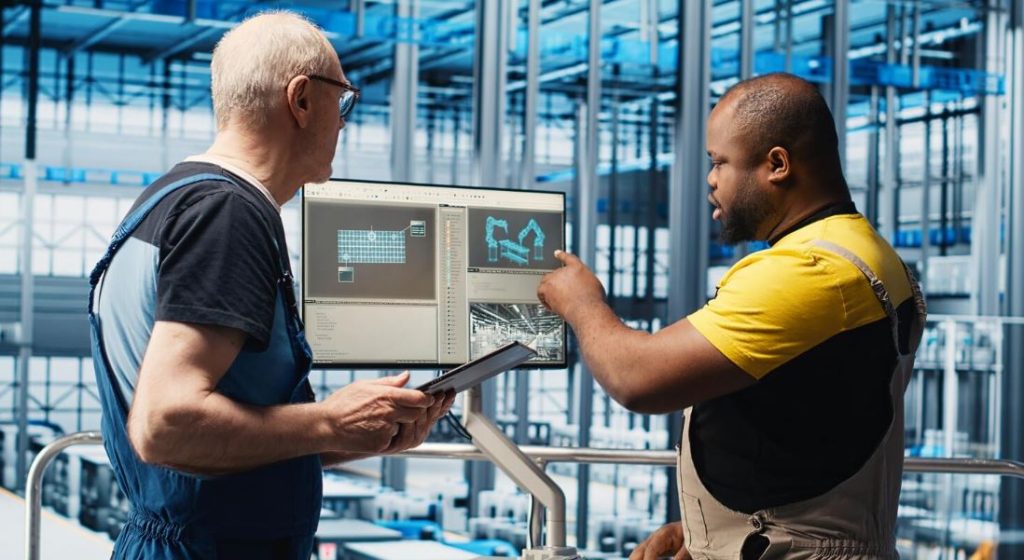
The first thing you notice when you enter a new battery plant in Kentucky or a semiconductor factory outside of Phoenix is not the size, but rather the silence. There aren’t as many people as you might think, and the ones that are there don’t have any moving parts. They’re looking at screens. The work is being done by the machines, who are now communicating with one another. One of the most peculiar growth stories on the market is being driven by this shift, which is taking place in real time across American factory floors: industrial automation has emerged as the fastest-growing sub-segment within a notoriously slow-moving industry, and a small number of businesses are reaping nearly all the benefits.
It’s already difficult to dispute the numbers supporting this. With a compound annual growth rate of 8.5%, the value of industrial automation worldwide is predicted to surpass $326 billion by 2032 from approximately $184 billion in 2025. Spending on factory automation is increasing at a rate of more than 10% annually in the United States alone through 2031. Robots, programmable controllers, vision systems, and sensors still account for nearly three-quarters of that, but the software and services portion is quietly expanding more quickly. Most casual investors overlook the fact that services compound at a rate of more than 12% per year.
Rockwell Automation, Emerson Electric, and Honeywell are the three names that frequently come up in supplier talks, analyst notes, and earnings calls. They’re all old. They’re all not as attractive as Tesla or Nvidia. However, the CHIPS Act funds, the Inflation Reduction Act funds, and the reshoring wave must all pass through this precise chokepoint. Motion control systems are necessary for every fabrication plant in Arizona. In Georgia, all battery plants require process automation. The picks and shovels must be sold to them by someone.
Rockwell is arguably the best example of American reshoring. There are Allen-Bradley controllers everywhere. If you enter an Ohio plant, the likelihood that the PLCs operating the line are Rockwell’s is more than 50%. The order book presents a different picture than the quarterly noise, despite the company’s past mistakes with inventory cycles and inconsistent margins. It’s interesting that management has been cautious about discussing the pipeline. That typically indicates that the pipeline is working properly.
Of the three, Emerson is the most intriguing since it has been reinventing itself for years. With the NI deal and its acquisition of AspenTech, it has shed industrial units and moved further into automation software. Emerson seems to be attempting to transform into a different kind of business, with more code and fewer valves, and the market hasn’t fully embraced this yet. Execution is the key to whether that succeeds, and a 130-year-old conglomerate rarely excels at execution. The direction is correct, though.
Honeywell seems to be the room’s silent giant. Most people are unaware of the ways in which its Process Solutions business affects data center construction, pharmaceutical facilities, and oil refineries. Value that has been hidden inside the conglomerate structure for years may be unlocked by the company’s proposed division into aerospace, automation, and advanced materials. Splits don’t always fulfill the promises made in the pitch deck, despite investors’ apparent belief that they will. The degree of cleanliness of the separation is still unknown.
Here, there’s something more significant to observe. Immigration policy and wage increases won’t close the labor gap in American manufacturing, which currently stands at 750,000 unfilled jobs and is expected to rise to over 2 million by 2030. Cobots, machine vision, and predictive maintenance software are helping to solve it. That is not a five-year pattern. That’s ten years. And without much fanfare, the three businesses in the best position to sell into it are already doing so, quarter after quarter. The stories that nobody is shouting about are sometimes the biggest ones.