
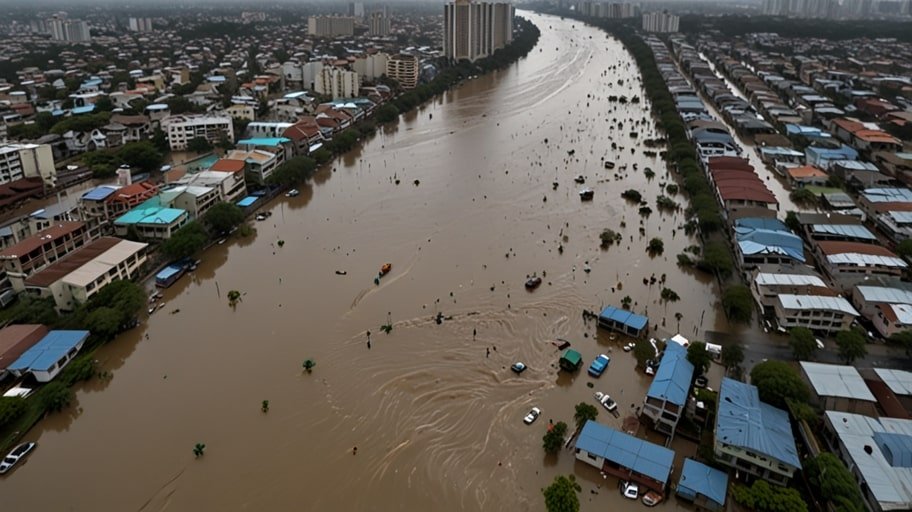
A powerful typhoon hit the Philippines’ Luzon island on June 5, 2025, killing more than 20 people and forcing tens of thousands to leave their homes. The storm, Typhoon Carina, affected Manila and neighboring provinces by smashing them with 180 kph winds, causing floods and landslides. Rapid interventions are ongoing to save people who are stranded.
Though people in the region were alerted in advance, the typhoon still caught them by surprise when it landed at midnight. Parts of Quezon City were fully submerged because of heavy rains, turning streets into rivers. Landslides covered homes in rural regions, trapping families inside. Failed power lines caused millions to lose electricity and made it difficult for people to communicate.
First thing in the morning, coast guards manned their boats and drove along the flooded streets in the city to help trapped people. People living in remote areas were rescued by military helicopters since the roads were too dangerous to travel. The government said that over 300,000 people have taken shelter in temporary places and feared that casualties could rise during search and rescue work.
All of the hospitals in Manila are struggling to treat patients with wounds from major flooding and storms. Because medical supplies are limited, people are being asked urgently to donate. Volunteers are handing out food and water to people taking refuge in crowded shelters, and they are anxious about what will happen to their houses.
Several days before everything else, the Philippine Atmospheric, Geophysical and Astronomical Services Administration said a storm was approaching, but the typhoon was stronger than expected. Storm surges completely destroyed boats and homes belonging to fishermen and people living by the sea. People who weathered the tsunami recalled that possessions were wiped away in seconds as huge waves broke over the seawalls.
The President declared a state of emergency and allocated national resources to help those in need. The government is collaborating with foreign aid organizations to supply help to affected areas. Schools and gymnasiums are struggling to offer housing to families that have lost everything due to the disaster.
After the disaster, it has become apparent that the country’s infrastructure needs improvement. The drainage networks in Manila, set up in the past, could not handle the massive rain, making flooding worse. There is a view among critics that the population in cities has increased faster than the boundaries of urban planning, making the area prone to catastrophes. More and more people are urging change to stay modern.
The Internet is full of messages from people asking for assistance, and many photos show people struggling in floods. People in local groups have organized themselves to provide essentials to harder-to-reach regions. Support coming from various directions shows how strong Filipinos are after experiencing many natural disasters.
The financial impact is huge, and agriculture and fishing businesses are the hardest hit. The flooding in rice fields threatened the city’s food security. The markets along the coast of Batangas were completely ruined, and this led fishermen to lose their livelihoods. Initial predictions show up to billions in damage, meaning it will probably take many years for the area to recover.
Many nations are sending aid, and Japan and Australia are donating emergency supplies and rescue teams. The United Nations has started a fund to assist with the rebuilding process. The Philippines’ experience with many typhoons is famous for its resilience, but this time, because the storm was so fierce, communities across the nation have been put to the test.
Experts think climate change is resulting in more and worse tropical storms like Typhoon Carina. Higher sea temperatures and unusual atmospheric changes are increasing the dangers around the Philippines. Some are now working to ensure worldwide actions are taken to limit future disasters.
Some who survived the disaster told of their experiences during the attack. A resident of Quezon City said she held onto her children as the water climbed, and a fisherman in Batangas stated that he needed to swim for a long time before finding dry land. These stories highlight the harm caused by the typhoon and show how important it is to prepare better.
The government is investigating the late release of evacuation orders in rural areas. Communication lapses caused some places not to be notified of the severity of the storm. Engineers are examining damage to bridges and power lines to decide which repairs must be made first.
People living in cities are joining forces, removing debris and sharing the little they have with each other. Local groups and religious groups are giving out meals and clothes to those who require them. People in the region are showing the social support called bayanihan as they work on rebuilding their communities.
The Council is monitoring additional risks, such as disease outbreaks among people being sheltered in the same area. Health officials are providing access to clean water due to the usual increase in waterborne diseases after floods. Government officials are getting ready for any additional consequences of the storm.
It is extremely saddening for families because they must cope with losing both loved ones and their homes. People affected by the tsunami are being given counseling services, since many have suffered greatly from this disaster. In the face of disaster, the Philippines proves itself strong, committed to making the country better than before.